When choosing from a range of options for our 2016 Ireland / Scotland cruise, Jenny was keen to choose an itinerary that included the Orkney Islands, partly because of a fascinating Neil Oliver documentary we saw a few years ago about some Neolithic archaeological sites, and partly because of its stunning landscapes. So it was with great anticipation that today we docked at Kirkwall, the capital of the Orkney Islands.
We’d always thought of the Orkneys as being incredibly isolated, but our tour today showed us just how wrong we’d been. In fact, this archipelago in northern Scotland has been of incredible strategic importance many times in history. Although in recent times forming part of Scotland and Great Britain, the Orkneys were for centuries a central hub of the Viking empires and have a deep and still-evident affinity with Norway. The Orkneys were also of great strategic importance in both WWI and WWII as the key naval base for Great Britain at Scapa Flow, and had several military airfields during WWII. There were reminders of this military past of the Orkneys dotted all around the island.
We joined a small, privately booked minibus of 14 people plus Jack, our very knowledgeable and enthusiastic guide (an ex Londoner), and Robert, our driver (came here from Edinburgh 4 years ago to be closer to the grandchildren), for our tour of the island. It did not rain at all during the day (for once), but even for summer, it was cold (12 degrees)! Jack told us that we were on the same latitude as St Petersburg in Russia, Hudson’s Bay in Canada, and southern Alaska in the USA. The feel of cold today was greatly increased by a strong nor-westerly wind straight off the Atlantic.
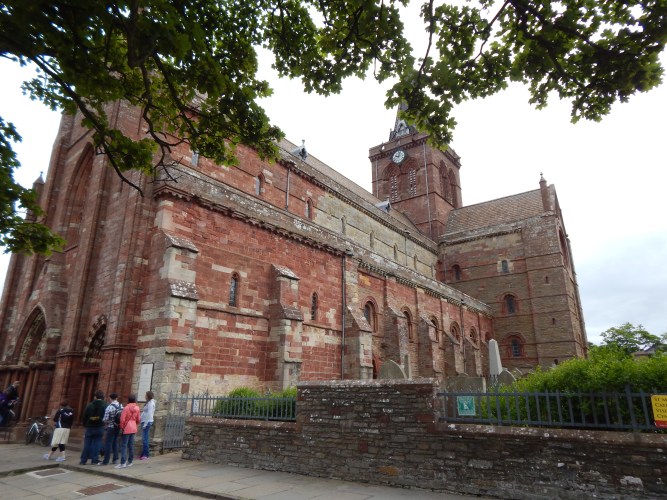
Despite their geographic isolation, or perhaps because of it, the Orcadians (people from the Orkneys) have developed a strong, individualistic culture. Being a long way from London, Edinburgh and Norway, the people are independently minded, even today. As an example, their Cathedral, St Magnus Cathedral, is the oldest Christian Cathedral in Great Britain and was begun by the Vikings in pre-Norman times. It was built slowly (over about 200 years), is now owned by the local government, and is used for both Presbyterian and Catholic worship (the religious wars of the 1400-1600s seemed to have passed the Orkneys by). We spent some time in this 1100 year old cathedral and it was stunning, constructed from locally quarried sandstone and simply beautiful. Unlike so many of the churches and cathedrals we’ve seen in our travels, St Magnus Cathedral has never been demolished and rebuilt, so virtually everything that we saw was original.
A major reason for coming to Orkney is that it has many Neolithic sites where later stone age people lived as they made the transition from hunter gatherers to farmers. These sites are now world famous, are all 5,000 years old, and precede the Giza Pyramids in Egypt, and Stonehenge in England. The most stunning of these is Skara Brae, but they also include Maeshowe, the Ring of Brodgar, and the Stones of Stenness,which all together form the Heart of Neolithic Orkney UNESCO World Heritage Site.
Maeshowe and the Ring of Brodgar
Maeshoweis a pyramid-shaped Neolithic burial tomb, found in a farmer’s field, covered with grass to form a huge mound, and surrounded by a deep circular ditch. It is an extraordinary structure, made of huge slabs of stone, carefully stacked one on the other. Entering Maeshowe requires stooping, literally bending over double to pass through a low, 10 metre corridor into a central room or chamber. It was an eerie sensation, delving deep into the hillside, giant slabs of local sandstone forming the walls and roof of the passage, our only protection from the tonnes of clay and soil above our heads. It was reassuring to know that the passage and chamber were constructed more than 5000 years ago (well before the pyramids of Egypt), and haven’t moved since!
It was explained to us that Maeshowe was constructed in such a way that, at the winter solstice, the setting sun, between two large hills in the distance, strikes through the entrance corridor like a laser and lights up the entire tomb in golden orange. Jack says he has been in the tomb and seen this happen, and that it is spectacular. The tomb also contains Viking graffiti, for around 1000 years ago a Viking band discovered the tomb and broke in through the roof, sheltered there, and carved runic messages all around the walls. This graffiti has apparently turned out to be of great value to modern archaeologists, as they have been able to use it to prove that some very early written accounts of Viking sagas were actually true.
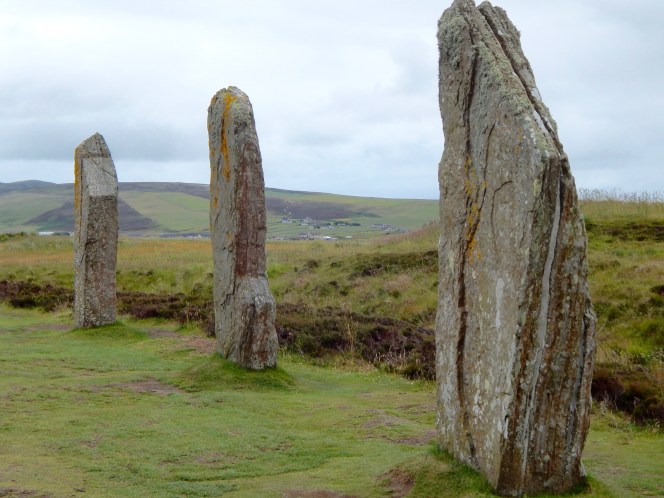
The Ring of Brodgar is just down the road. It is a stone circle like Stonehenge, but without the large supported lateral stones, and is much older. Again, it is found in a farmer’s field amongst the heather and cows, though the cows are kept away by fences. It is considered one of the best preserved stone circles in Britain, and many of the original 60 stones are still standing. Unlike at Stonehenge, one can walk right up to these stones and examine and touch them. It was wonderful to walk amongst them and imagine the societies that might have built and treasured them.
Skara Brae
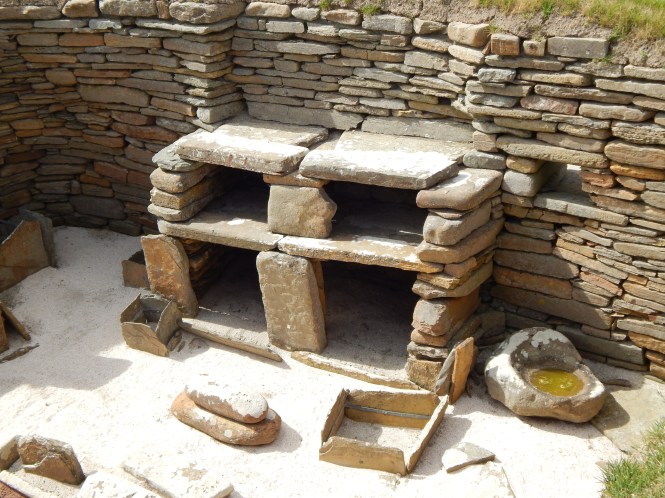
We had been looking forward to visiting Skara Brae since seeing it featured on the TV documentary several years ago. This is a Neolithic village, 5,000 years old, in modern times set right on the ocean, made from stone, and buried and preserved in sand for millennia. Skara Brae was totally unknown until parts of it were unearthed by a storm in the 1850s and discovered by the landowner, and from there excavations began to occur. Now some of it is unearthed, revealing a complete, amazing collection of Neolithic stone houses. Each house comprises one room, with the central hearth clearly visible, beds situated along the walls, and even stone display shelves built into the walls. According to researchers, these folk were much like us, hunted for deer, ate seafood and shellfish, and either grew or collected barley. Skara Brae is not only wonderfully preserved (apparently sand is a good preservative), it has proven that Neolithic societies were far more advanced than previously thought. Together with its natural setting on the shore of a beautiful bay, visiting Skara Brae has been one of the (many) highlights of our entire trip.

After a tiring but intriguing day, including a very welcome lunch at a local pub, we returned to our ship, satisfied that our visit to the Orkney Islands had lived up to our expectations!
 Adventures for Two