This was the second leg of our road trip around New Zealand in February-March 2015. The ferry journey across the Cook Strait lasts about three hours, and it was thankfully uneventful as the seas were calm on this February day in 2015. One can find videos on YouTube showing what can happen when the seas are rough – vehicles sliding around the decks, bumping into each other and, once or twice, even falling overboard. Many care hire companies will not allow their cars to cross the Strait, and hirers have to re-hire a new car on the South Island. We deliberately chose a company that did allow the crossing as it is far more convenient, and luckily their car came to no harm on the placid day we crossed.
The ferry disembarks on the South Island in the pretty coastal town of Picton, and here we stayed for one night before continuing on our journey south. We arrived around lunch time, and after lunch took a walk around this pretty town, sat on its lovely lawns near the harbour, and took in the beautiful day. Here we also decided to visit the Edwin Fox Maritime Museum, which features the 9tholdest ship in the world, the Edwin Fox, which is also the oldest surviving ship to have transported convicts to Australia (to Western Australia, in 1858). Having first sailed in 1856 and, amongst many other duties, having transported troops to the Crimean War and served as a commercial vessel, the Edwin Fox ingloriously served out its days as a storage ship before finally being abandoned in Picton Harbour. After many years it was re-floated and towed into dry dock at the museum, where it stands, deliberately unrestored, as a fascinating testimony to maritime history. Well worth the visit.
 From Picton we took the spectacular drive down the east coast of the South Island to the small township of Kaikoura, where we stayed for two nights in lovely accommodation high on the ridge above the town, overlooking the sea to the east and the extraordinarily beautiful mountain ranges to the west. These ranges, in winter, are one long chain of soaring snow-capped peaks, and are the ones featured in the Lord of the Rings movies and in many renowned photographs. No snow in February, unfortunately, but they were beautiful just the same.
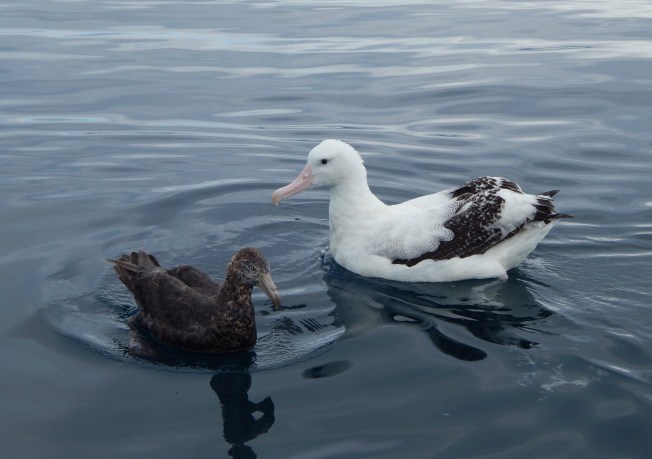
Our highlight at Kaikoura was joining a small boat tour which goes 5kms off shore, above a 5,000 metre deep-sea trench located very close to shore, where ocean birds gather to feed. Here we saw numerous albatross and great petrels and lesser sea birds in the wild, and it was absolutely magnificent. What huge and beautiful birds the albatross are, and on the way back to shore, with the boat charging through water at high speed, these majestic birds easily kept pace with and frequently passed our boat, such is their speed, grace and power.
Leaving Kaikoura we headed south down the beautiful coast road (which was badly damaged the following year, November 2016, in a magnitude 7.8 earthquake), before heading west and inland, via Hanmer Springs, on our long drive to our next stop, Greymouth, on the west coast of the South Island. Here we stopped for the night, before heading off to the object of our visiting this part the west coast, the Franz Josef and Fox Glaciers.
The drive down the west coast to the glacier country, and then further south down to Lake Wanaka, is truly beautiful. Around every turn and over each hill one seems to be confronted by another stunning mountain, forest, cliff face or broad mountain river valley with its rushing stream and narrow bridge. We arrived firstly at the township of Franz Josef Glacier, where we had booked into the West Coast Wildlife Centre for its 1pm session to hear one of their researchers explain to us, amongst a small group of 8 people, the nature of kiwis (the birds, not the people), how they live and breed, why they are susceptible to predators, and the nature of the Centre’s breeding and kiwi re-population program. We also saw several baby kiwis, and a number of eggs under incubation. This was a fascinating and worthwhile lecture and tour, and it was wonderful to hear these scientists speaking so passionately about their work. In the afternoon we visited the glacier itself, taking the shorter forest walk to the viewing platform. This was worthwhile, although rain and cloud diminished the majesty of the spectacle. We then headed off to the Fox Glacier, where we were to stay overnight in the adjacent township.
Getting to the Fox Glacier involved a steep and longish walk, about 45 minutes each way, across loose scree and lateral moraines before one reached the main lookout. All the while helicopters raced above us, dwarfed by the huge cliffs and scree slopes carved out many thousands of years ago this powerful glacier. The walk was a little difficult, as you had to beware of slipping on the narrow, stony path, but it was worth it upon reaching the lookout and seeing the glacier reaching up into the valley. It was shocking though to view on the time-lapse photo display at the lookout the massive distance the glacier has retreated back up the valley in just 80 years. Global warming? It’s real.

The drive immediately out of the glacier country was equally as stunning and imposing as that which preceded it. We have nothing like these mountains in Australia, which is an ancient and well-worn continent compared to the dynamic volcanic and continental plate-influenced systems on which New Zealand is built. Suffice to say that our ‘Ohs!’ and ‘Aahs!’ did no justice at all to the stupendous views. We were heading south to the lovely town of Wanaka, located on the southern shores of Lake Wanaka; a town which in the summer offers all sorts of water sports, and in the winter is home for many holidaying skiers who flock to the adjacent fields.
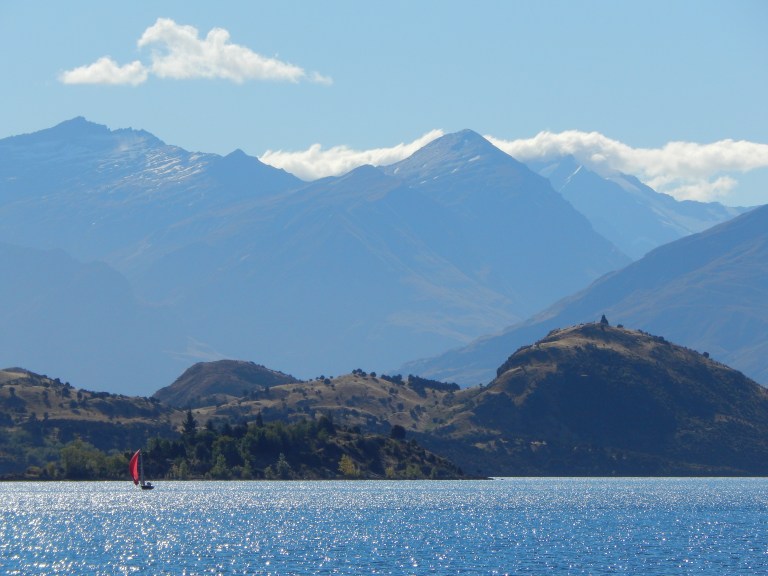
We stayed in Wanaka for two nights, prior to our heading back north up to Aoraki/Mt Cook, New Zealand’s highest peak and often scaled by Edmund Hillary, where we were to spend three nights, including the day of Steve’s birthday. Wanaka is a pretty town, and we enjoyed the long walks along the pathways that border the foreshores of the lake. However, apart from the restful ambience of the town, the highlight was taking the 10 minute drive north of Wanaka to visit the National Transport and Toy Museum– a vast array of buildings and yards housing an incredible historical collection of toys and games, and cars, trucks, planes, helicopters and military vehicles from every era imaginable. According to its website this private collection contains 600 vehicles, 15 aircraft and over 60,000 toys. We could not begin to guess the value of this collection, with so many of the vehicles having been lovingly restored. We think between us that every car we have ever driven, up until and including the 1980s, is in that collection. It was truly outstanding, and in our view something of a well-kept secret.


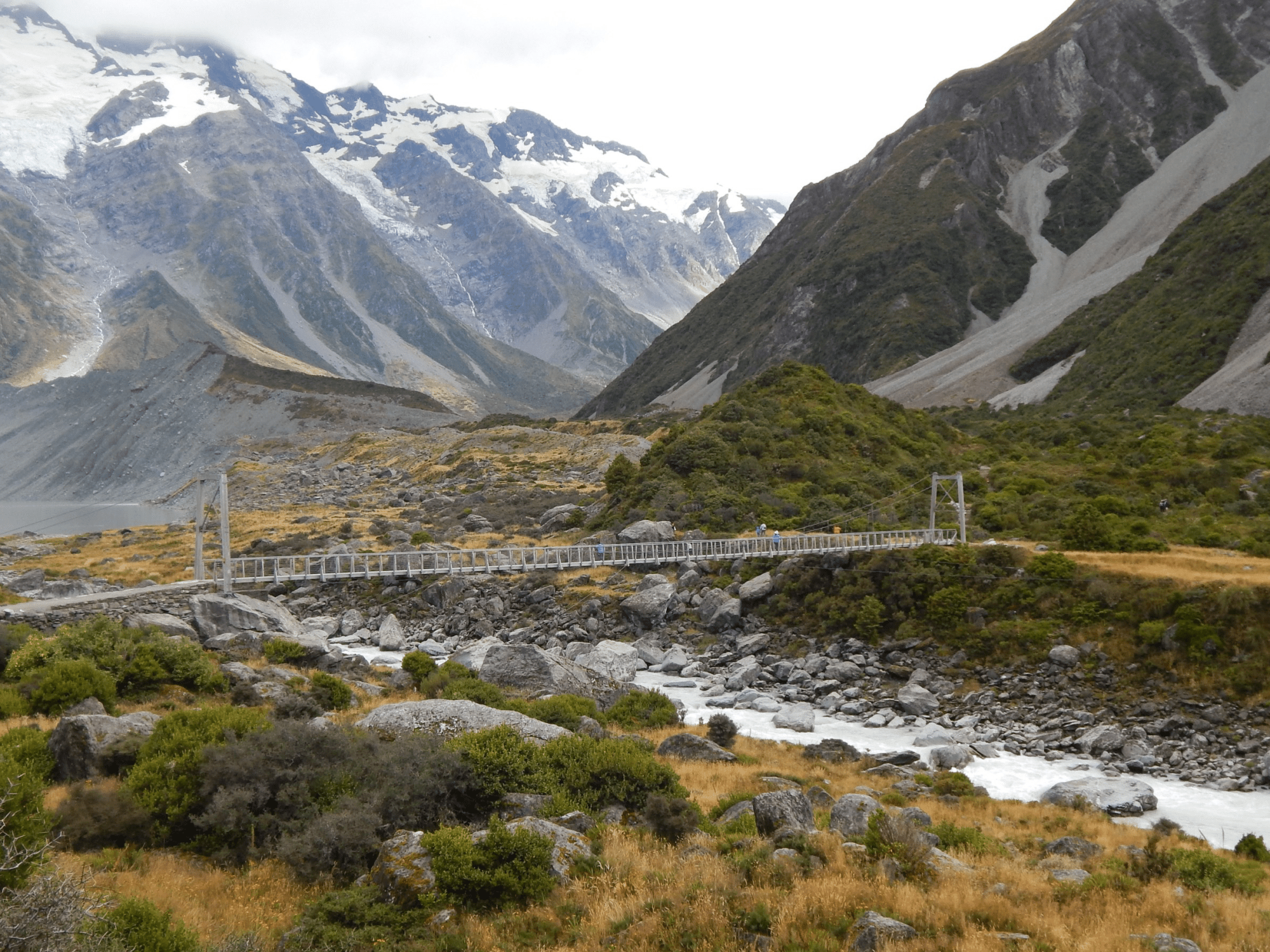
Wanaka was the furthest south we had planned to go on this trip, so there is a whole lot of the southern part of the South Island still left for us to explore. The trip to Aoraki/Mt Cook took us north through Omarama and Twizel, and along the shores of the stunning Lake Pukaki. On a clear day, with Mount Cook visible, one can get extraordinary photographs of the huge mountain standing imposingly at the end of this long lake. Unfortunately, as we learned, Aoraki/Mt Cook is a shy beast, frequently surround by cloud, and while we could photograph the beautiful lake on this day we were not able to see the two together.

It was the same story for the three days we spent at the Mount Cook Village – a good view of its smaller cousins, and of the lower slopes of the massive mountain itself – except for just 15 minutes as we celebrated Steve’s birthday in the restaurant of the Hermitage Hotel, where we stayed while there. For just 15 minutes on that evening, through the restaurant’s huge viewing window showcasing Aoraki/Mt Cook, the clouds parted, and in the moonlight there stood the whole, huge mountain, in all its white-capped glory, plumes of snow slowly drifting off its peak in the upper-air winds. A wonderful moment I think we will never forget. Unfortunately, all too soon the shy sentinel once again drew closed its curtain of cloud, and we did not see the summit again in our time there. We did however go on several lovely walks, cross fast-moving streams and enjoying the scenery. A very enjoyable and restful few days.
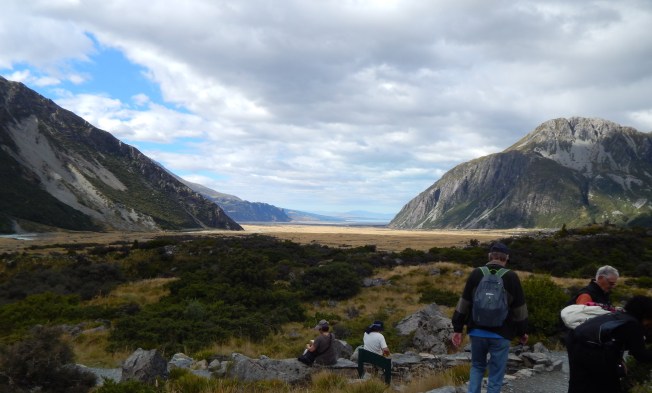
Our final destination in our three week driving tour of New Zealand was Christchurch. The drive east and then north to Christchurch was another beautiful drive, with rolling foothills and valleys, often riven by extraordinary fault-lines caused by past earthquakes and subsidence. We could not help thinking how uncertain life must be for the people of the South Island. This was clearly brought home to us when we reached Christchurch and saw the amount of demolition and building repairs that were still being undertaken following the huge and destructive earthquakes of 2010 and 2011 – two events which in total resulted in the deaths of 185 people.
The impact of these quakes on the city was still quite evident. Many blocks in the town were bare, and many buildings were either still unsafe, had been too damaged to repair, or had been demolished. A few new buildings had been built, and there was certainly a construction boom underway. The city’s Cathedral had been badly damaged, and even in 2015 its tower was still under repair. We took our morning coffee from one of a number of shops cleverly housed in reconstructed shipping containers in one of the city’s small squares. A highlight of our time there was visiting Quake City: Christchurch Earthquake Museum, which documents the history of earthquakes in New Zealand and the Canterbury Regionin particular. The museum showcases an extraordinarily resilient city, region and country across several centuries. It contains amazing artefacts, video and photographs documenting the history of earthquakes in the formation New Zealand and their impacts on its human populations, and is really worth the visit.
Dropping in our trusty hire car, which had transported us almost the entire length of the country, we headed out to the airport and departed for Brisbane on Air New Zealand, this completing our driving tour of the South Island, and a tiring, but worthwhile holiday across both Islands. We do hope to head back at some stage to see some more of the country down in Otago and Southland that we missed on this trip, but we maintain enduring memories of our first trip to New Zealand.
 Adventures for Two
Did you take that pic of the albatross?? Never known them to sit in water like that
LikeLiked by 1 person
Yes we have video footage as well. The boat takes tours to see deep sea birds and travels out into the trench area about 5km off Kaikoura. They drop food into the water and the birds come flying in, gliding low across the water, and settle onto the water to fight for the bait. Petrels also come in. Fantastic to watch.
LikeLike
Oh what a treat….never heard of that before. Did you see any whales?
LikeLiked by 1 person
No, no whales I’m afraid. The tour was specifically to see the deep water birds. Was wonderful. Have just checked, we did put a short video footage of a gliding albatross in the blog. Have another look and see if you can see it.
LikeLiked by 1 person