Following our driving tour of New Zealand in February 2015, this was our next big trip since retiring at the end of 2013, and one we had wanted to do for years – to see some of those exotic places in the eastern Mediterranean that we had only previously read about. The trip was essentially a cruise lasting three weeks during September and October of 2015, beginning in Istanbul, Turkey, and concluding in Venice, Italy. Along the way it took us to five countries – Turkey, Greece, Albania, Croatia and Italy (we had only ever been to Italy prior to this). Following our disembarkation in Venice we spent a few more days in Venice and then a week in Verona, Italy, before flying home to Brisbane.
Our cruise company was Voyages to Antiquity, which operates a single cruise ship, the Aegean Odyssey, and specialises in visiting ancient sites. The ship is not a large one, having a maximum capacity of around 370 passengers. While it has the requisite bar, bistros and internal and outdoor dining, it is not a ‘fun ship’ – no casinos or clubs, and no dancing after midnight. Just our cup of tea. The vast majority of passengers seemed to be retirees, attracted by the quality of the ports we visited, the tour options, and the nightly lectures provided in relation to each of the historical sites we visited.
What follows is a quick account of what was a marvellous and enjoyable trip.
Turkey
We began our tour in Istanbul, a fascinating city: very modern but architecturally diverse and amazing. The people are proud and patriotic. All our guides were very knowledgeable, very fixated on the religious history of the city and very proud of the gateway between the east and west that Istanbul has always represented. It’s a city well worth seeing, although since we were there, increased levels of political unrest have prompted the Australian government’s travel advisory service to suggest exercising extreme caution. Over two days, we toured the old city and the Grand Bazaar, the Hagia Sophia, the Blue Mosque and the Topkapi Palace, which is where the Ottoman sultans used to live.
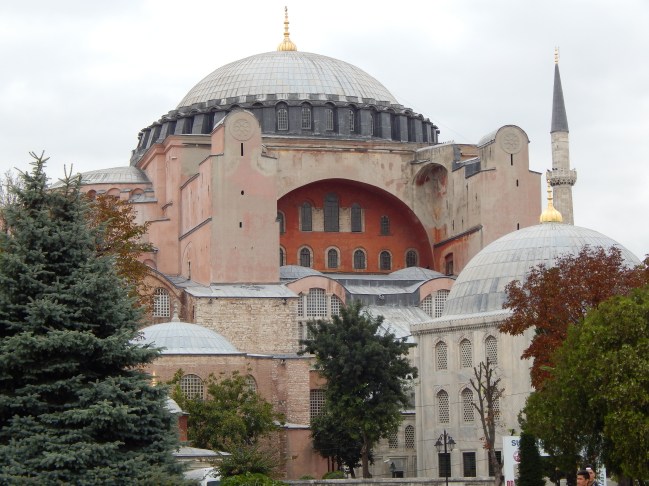
The Hagia Sophia, constructed in 537 AD, was originally an Eastern Orthodox cathedral, but has also (at various points in history) been a Roman Catholic cathedral and an Ottoman mosque. It was the world’s largest cathedral for almost a thousand years, but is now a museum. It’s quite surreal to walk under its impressive dome and gaze at the fragile frescoes and mosaics, marvelling at the architectural genius that has survived earthquakes as well as the ravages of time.
The Blue Mosque (Sultan Ahmed Mosque), built in 1616, is much younger than the Hagia Sophia, but just as impressive in its own way. Its distinctive domes and minarets make it almost instantly recognisable. We queued for quite some time before we could enter, having removed our shoes and donned head coverings, but it was certainly worth the wait. Hand-painted blue tiles adorn almost every wall, illuminated by beautiful stained-glass windows and (more modern) chandeliers. Despite its age, it still functions as a mosque so tourists are closely controlled.


After a quick visit to the crowded and over-priced Grand Bazaar, inside the walled city of Istanbul, a boat ride on the Bosphorus provided a different view of this fascinating city, where old and new seem to sit comfortably side by side. Along with our tour group, we were then taken to the Nakkas Oriental Rugs and Textiles shop. Not only were we shown some beautiful high-quality Turkish rugs but, much to Steve’s delight, had our first taste of true Turkish Apple tea. Beautiful as the rugs were, however, the true highlight of this visit was traipsing down the stone stairway to the carefully restored Byzantine cistern below, now used as an art gallery and function space.
Our final visit in Istanbul was to the Topkapi Palace. Once the main residence and headquarters of the Ottoman sultans, and now operating as a museum, the palace retains the grandeur and opulence of bygone days. Queues to visit the many rooms filled with Ottoman treasures were very long, so we contented ourselves with wandering the beautiful grounds and venturing into some of the buildings previously occupied by the sultans’ harem. The views of the Bosphorus from here were stunning, views we were able to appreciate from a different angle as we set sail from Istanbul at sunset.


Our next stop in Turkey was Gallipoli, which was amazing. As teachers, we have both taught the place of Gallipoli in Australia’s history to school children for many years. To see and walk on the beach at Anzac Cove, to look out at the placid waters which were so violent in April 1915, and up at the terrain the troops once fought their way up and over from the beach, to visit Lone Pine, the Nek and the front line trenches which were only a few metres apart, was just amazing. So many Australian graves, all young men, most under 25 years of age and many under 20. We are so glad that we elected to visit this site.


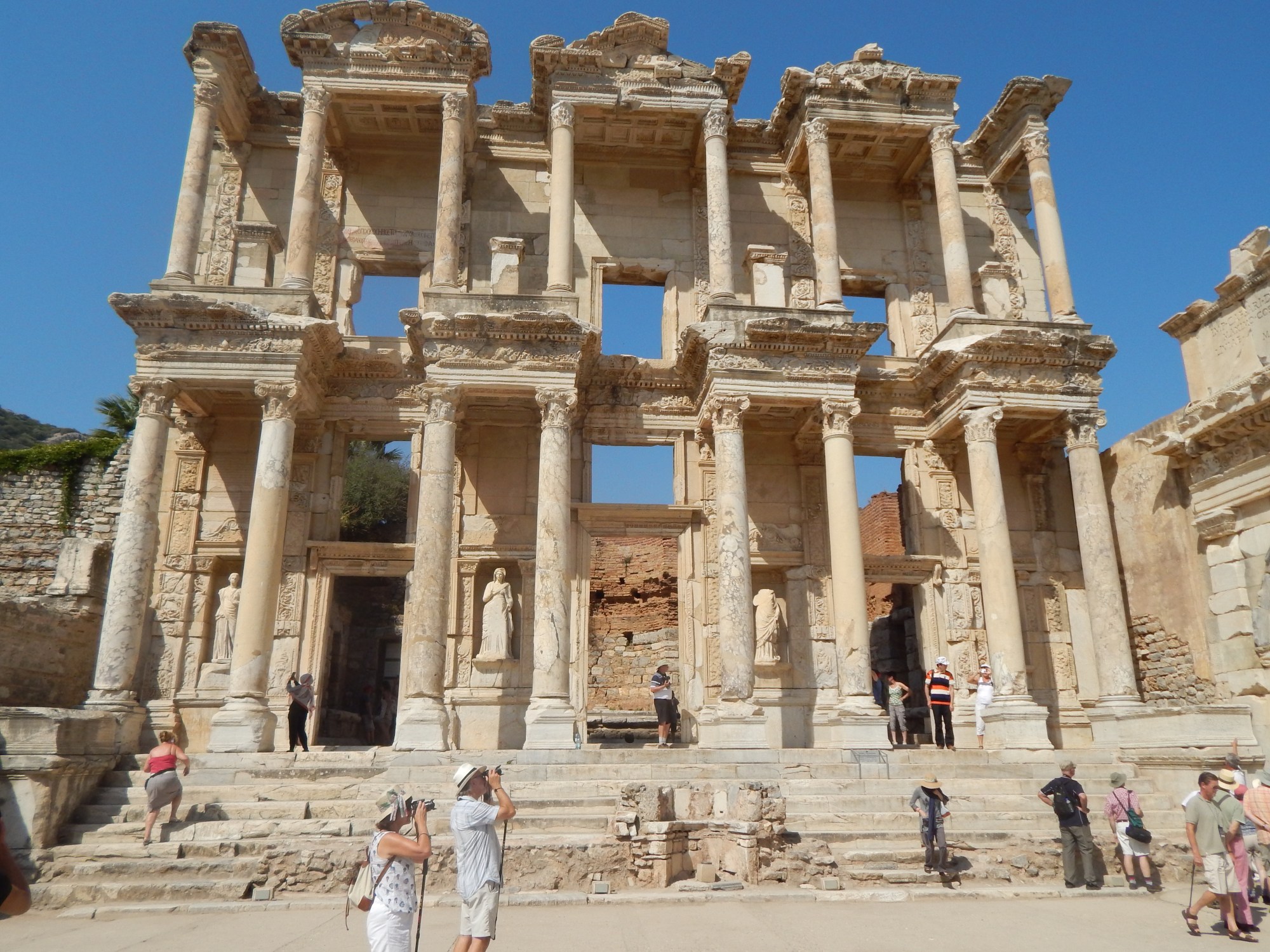
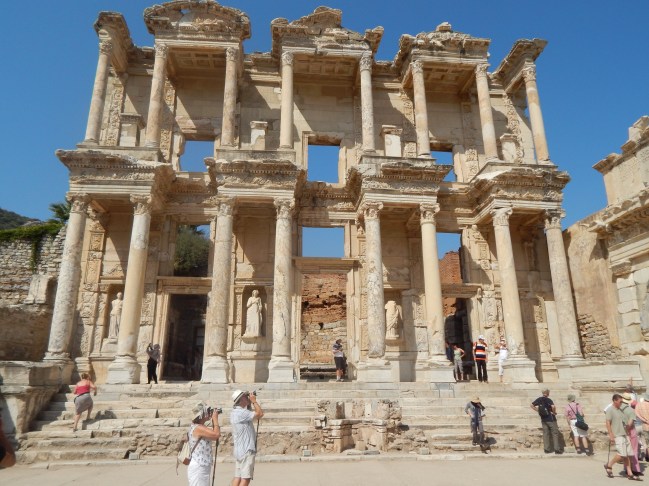
From there Jenny went to Ephesus near the modern day port of Izmir (Steve was sick and didn’t go). Ephesus dates from the 10thcentury BC, when it was established by the Greeks, although it later came under the control of the Romans. It has fantastically well-preserved ruins (and some that have been reconstructed from pieces found there) and was once, in antiquity, the home of The Temple of Artemis, one of the Seven Wonders of the Ancient World. Two expected highlights of this tour were the Library of Celsus and the Grand Theatre where, apparently, St Paul used to preach. An unexpected bonus, however, was a tour through the excavations of the Roman ‘terrace houses’, built into a steep hillside, which give a little insight into how the wealthy citizens of Ephesus lived in the Roman period.


Over the following two days we were both sick (one of the hazards of cruising!), and unfortunately missed the ancient Lycean cities of Telmessos and Kayakoy.
Greece
Because of illness (apparently, ‘travellers’ flu’), we also missed our first (much anticipated) Greek port of call: the island of Rhodes, though it looked wonderful from the ship and we think we’ll have to go back one day. Our ship also avoided the scheduled visit to the island of Kos, which had been in the news at that time because of the thousands of refugees arriving from Syria. We missed this port mainly because all the docking facilities were tied up by ships providing emergency accommodation for refugees.
So, our first Greek port of call was Heraklion, in Crete, the site of the ancient Minoan civilisation (peak 2000-1400 BC) and the Palace of Knossos. Steve was feeling well enough to go to the Palace of Knossosby this time, though Jenny was still sick and didn’t go. The Palace was very interesting (and very crowded, despite the rainy day), but we both went the following day to the new Heraklion Archaeological Museum, which while only small is for its size one of the best museums we’ve been to. It was packed with exquisite tools and art objects ranging from 10,000 BC through to Classical Greek times, many in outstanding condition and recovered from several of the Minoan palaces found on the island. Its secret is that through careful management by its early archaeologists, the treasures from this small island were not plundered and removed from the country. This has the reputation of being the best Minoan museum in the world, and it was wonderful. The Cretans justifiably see their civilisation as pre-dating, and in some senses giving birth to, the Classical Greek civilisations found on the mainland.


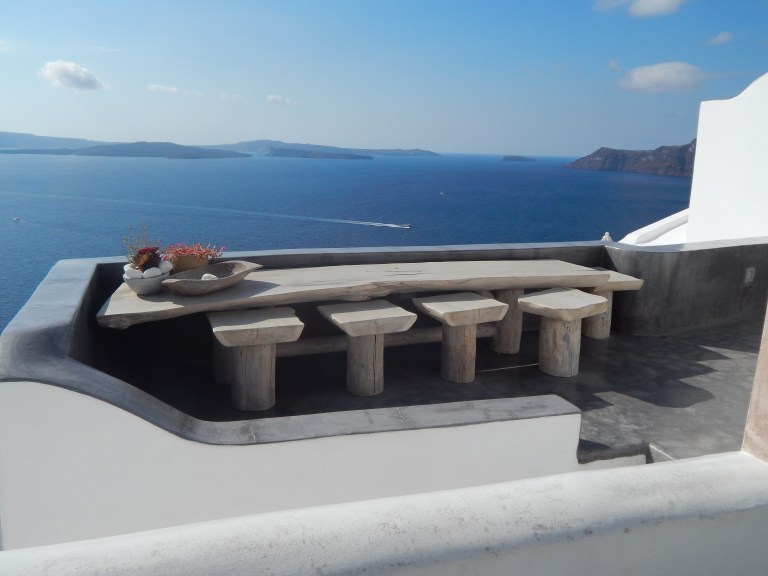
From Crete we went on to Santorini, which is now the remainder of a once much larger volcanic island blown to pieces by a volcanic explosion in antiquity (one theory is that this explosion marked the end of the extraordinary Minoan civilization on nearby Crete). Santorini is perhaps one of the most recognisable islands in the world: a picturesque, buzzing island of three major towns, amazing white-washed buildings clinging to cliffs and towering views of the intense blue water of the caldera. It was packed with tourists, particularly young people, with lots of cafés and shops. We first visited Oia, where we browsed in art galleries and purchased a beautiful artistic figure made by a local artist from the reconstituted light volcanic rock which covers the island. This was later delivered to us in Australia with no dramas.
Santorini is also the site of the ruins of Akrotiri, an ancient Minoan settlement dating from about 3600 BC, which was destroyed in a volcanic eruption in 1627 BC. Here archaeologists have excavated much of an entire town, leaving evidence in extraordinary detail about how the people of the time lived. The ruins are well-preserved, having been buried under many metres of volcanic ash. Remains have been found of a sophisticated system of hot and cold water pipes, water closets, and frescoes depicting the daily lives of the citizens.
A short bus trip then took us to Fira, the main town on the island, filled with narrow cobbled streets lined with art galleries, restaurants and shops, and once again crowded with tourists. To get down from the town back to the ship we had to take a cable car down the cliff. A big gold star to Jenny – she overcame her fear of heights admirably, helped greatly by the understanding shown by the other passengers in our car. Looking back up at the cliffs from the ship is certainly an impressive sight.


Following Santorini, our ship made quick stops on the island of Delos, once the religious centre of the Aegean and home of the Delphic Oracle in the 5th century BC, and Mykonos. A leisurely stroll around Mykonos, which is a pretty port town/fishing village filled with European designer stores with Paris prices (must be the Greek Riviera). Scores of tourists thronged the narrow cobbled streets (is there a pattern here?) in search of a bargain, and flocked to the harbour for the obligatory photos of the old windmills.
and windmills at Mykonos


Our final stop on this first leg of our cruise was the port of Piraeus, gateway to Athens and the Acropolis! After a short bus tour of some of the sights of Athens, we headed up the hill to the most famous of all Greek heritage sites. The Acropoliswas crowded, but wonderful! Seeing the size and scale of the Parthenon, built in the 5th century BC, and the adjacent Temple of Athena, is just amazing. Good luck with taking photos without including other tourists, though.


Coming down from the Acropolis we walked to the Acropolis Museum, which houses many artefacts from the Acropolis, but which also has many plaster replicas of original artefacts such as the ‘Elgin Marbles’ which are currently housed in the British Museum having been looted from the Parthenon and other buildings in the 1800s. The Greeks are making the point that these should be returned home to the world class museum in Athens that they now have waiting to house these wonderful but vandalised treasures. Having visited the Acropolis, and then the museum, it’s difficult to argue that the treasures shouldn’t come home!
 Adventures for Two