We took this very worthwhile two week cruise around the British Isles in July, 2016. This was a good way to see, in a short time, something of Ireland and Scotland – two countries we had not been to before – with the islands of Guernsey and Orkney, and the French port of Le Havre, thrown in. We travelled on Caribbean Princess.
St Peter Port, Guernsey
Cruising in the late afternoon down the Solent and around the Isle of Wight we then progressed overnight to the independent islands of Guernsey, which lies very close to the coast of France. Our destination was St Peter Port, the main port and capital city of Guernsey.
St Peter Port was a delight – such a pretty town, and the sun was shining and the air was crisp and beginning to warm. The island clearly likes its tourists, because there were many locals there to welcome us and provide us with maps to point us in the right direction. We chose not to join a tour group, but to walk up into the town and look around at our leisure. We particularly wanted to see the Guernsey Museum and Art Gallery, and the Guernsey Tapestry Gallery, which is the home to a very special contemporary project commemorating Guernsey’s history.
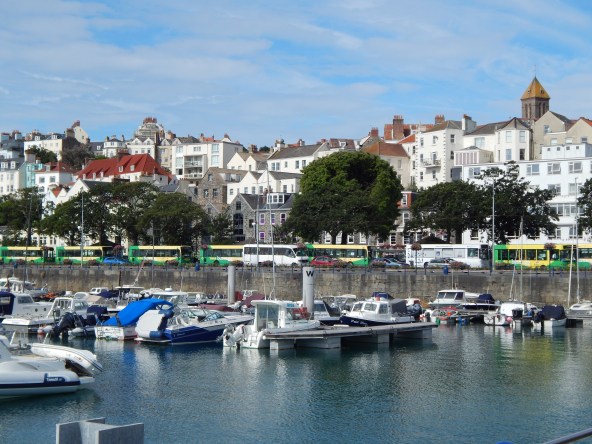
Traffic was quite busy in the town, but more scarce in some of the older, cobblestoned streets we walked up to get to the galleries. Having left these behind, we walked through the Candie Gardens, a small but beautiful park from where we were able to look down into the bay to get a photo of our new ship, and also photograph the statue of Victor Hugo, the famous French writer (and author of Les Miserables) who lived in Guernsey for 14 years (1870s and 1880s) during his exile from France. The house in which he lived is now a museum in his honour, and his statue is set in the Candie Gardens.
The newly renovated local art gallery had a number of small but very appealing exhibitions which kept us engrossed for a good hour. There was a fascinating exhibition of the works of local contemporary artists. One particularly fascinating piece, especially commissioned by the Gallery and popular with the locals, was called Tree of Life– very whimsical, clever and thought-provoking. A short walk through the more formal part of the gardens brought us back to our original destination – the Guernsey Tapestry Gallery which contains the Bailiwick of Guernsey Tapestry. This tapestry is monumental, and is not only a wonderful artistic and historical record of the lives of the people of Guernsey, but an incredible example of widespread engagement in a community project.
The Tapestry (or rather, embroidered canvas work) consists of ten panels each depicting a century in the history of Guernsey, and was produced to commemorate the Millenium. The panels, produced by each of the districts or bailiwicks of Guernsey, are stunning, depicting many iconic scenes and historical events that it’s easy to trace the history of the islands by studying the panels in sequence, and are beautifully displayed in their specially designed gallery (in carefully controlled conditions designed to ensure they last until the next millennium!). This fascinating gallery was not an option in any of the ship’s tours and was missed by most of the passengers. Such a pity!
Cobh / Cork, in Ireland
The following day we arrived in Cobh (pronounced Cove), the port that services the southern city of Cork, and our first stop in Ireland. Oh what a miserable day it was, with constant rain driven vertically by strong winds throughout the day. We decided not to do the bus tour (trying to see the countryside through the rain and mist would have been pointless!), but went just off the wharf to the Cobh Heritage Centre. This was set up in 1991 in recognition of the history of Irish immigration, both forced and voluntary, to all parts of the globe over the past 300+ years. We found it fascinating, particularly as Jenny’s family (on her mother’s side) has been emigrating (in one form or another) from Ireland to Australia since 1793, and Jenny has been researching this closely over the past three years. At least four Irish convicts, several free settlers, and one Irish famine orphan are among Jenny’s ancestors who found themselves making new lives in Australia, and some of them sailed from the port of Cobh.
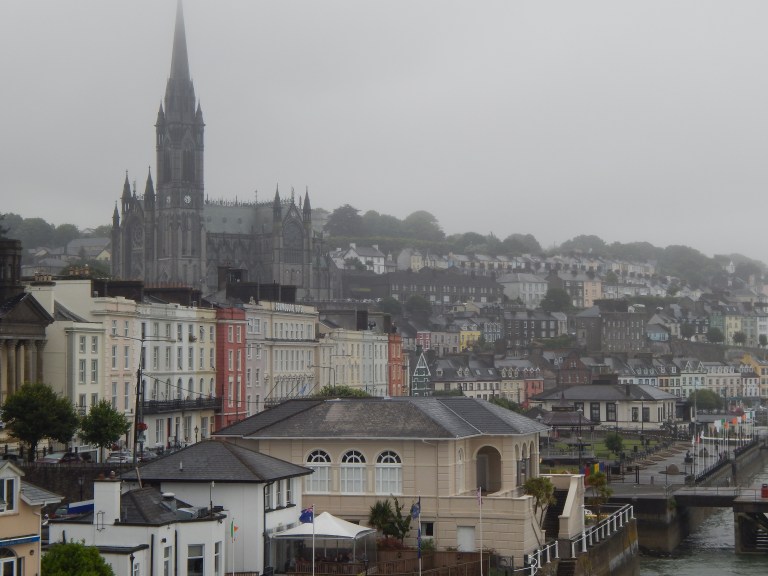
The Heritage Centre documented how Irish prisoners, particularly political prisoners, were the basis of what was effectively a slave trade to the Americas and Caribbean since around 1640, and how their transportation to the Americas had enabled much of their land to be stolen back in Ireland. Many other Irish, keen to escape poverty, went voluntarily to the Americas in the 1600s and 1700s as indentured labour, on labour contracts. Following the loss of America to Britain following the War of Independence in the 1770s, Irish convicts were then sent to Australia for a further 65 years. Irish free settlers also immigrated by their hundreds of thousands to the USA, Australia, Canada and New Zealand between 1800 and 1940, attracted by gold rushes and prospects of earning a living wage in an expanding economy.
As we sailed away from Cobh in the late afternoon, the rain cleared (of course!) and the sun began to shine, at least for a while. Finally, we were able to see the beautiful harbour of Cobh– the second largest natural harbour in the world (after Sydney Harbour). Looking at the landscapes of the various islands, the hills rolling steeply down to the sea, it was easy to see why Ireland is sometimes called “forty shades of green”!
Dublin and Glendalough
The following day was much better weather, and having docked in Dublin harbour in the morning, we caught our bus at 8.30 to take a tour of the city and then venture out into County Wicklow to visit the site of the 1,000 year old early Christian monastery, set between steep hills and two beautiful lakes at Glendalough.
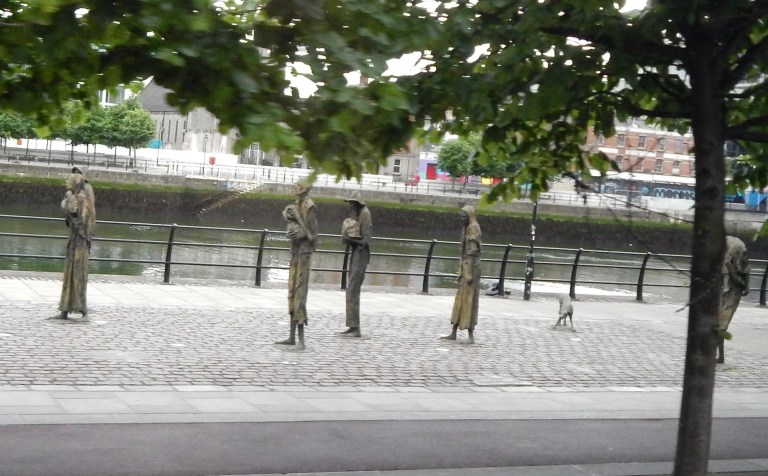
Our tour through Dublin city was very low key. Being a Sunday morning it was very quiet – our guide explained that Dubliners don’t emerge on a Sunday until midday, whereupon they then go to church and have coffee! The walled city of Dubh Linn was established by Vikings in 841 AD, and today has a cosmopolitan feel, valuing its history, but with some striking modern architecture including its “tube in a cube”, its “harp bridge” (apparently Dubliners like giving their iconic landmarks nicknames). As we passed by these lovely bridges and buildings we saw an emotional art installation, paying testimony to those millions who suffered and fled from Ireland because of the famines of the mid 1800s. When you read the history of this it was truly a terrible time in this country, and one that has left many scars and legacies.
En route to Glendalough we passed through some beautiful valleys and hills. The monastery at Glendalough was established in the 6thcentury AD by St Kevin, and was once a thriving hub of Christian scholarship and worship, and a large and successful agricultural community. Between 600 and 1000 AD, people came from all over Europe to study and write here, and people left the monastery to establish others in Ireland and greater Europe. In such monasteries, knowledge and science were preserved in western Europe following the fall of the Roman empire – the period of the ‘dark ages’, as they are known. Monasteries such as this helped to preserve the ‘light’, as the monks produced painstakingly hand-written copies of important texts, and preserved knowledge for future generations.


The buildings of the Glendalough monastery are wonderfully preserved, and it is a sobering experience to walk past those that are still standing, through the ancient and more modern graveyards, and past the ruins of buildings now fallen. A walk further up the valley towards the ‘upper lake’ gave a sense of the wonderful landscape of Ireland, and the serenity that St Kevin sought and found here. A wonderful experience to visit such a beautiful and thought-provoking setting
Beautiful Belfast
Belfast was our only visit to a city in Northern Ireland, which is of course part of the UK, not of the Republic of Ireland in the south. It is bustling, friendly city, bursting with commercial and artistic activity, and welcoming of visitors from around the globe. We really liked Belfast.
In Belfast, we took the shuttle bus from the dockside into town, a trip of about 10 minutes, and simply walked around the city for half a day. Down Royal Avenue through the commercial heart of the city we walked, stopping for a lovely Italian coffee on the way. Then down through the older part of Belfast to the imposing Cathedral situated opposite the Writers’ Square, passing by huge street art murals and public sculptures. Then over to the River Lagan which passes through the city on its way to the harbour, back through the Victoria Square with its ultra modern, massive glass-domed shopping centre, then back to the imposing Town Hall building to pick up our bus back to the ship.


Our favourites in Belfast? Firstly, the lovely, friendly feel of the city, and the lack of rush. Secondly, Writers’ Square, where memorable phrases from a range of accomplished writers from Belfast are inscribed into the concrete tiles all over the square (one such was, “Oh, what an environment for a man of imagination” – just one of the wonderful pieces of writing). And thirdly, the street art, which often covered the complete side of a building, and usually had both visual impact and a provocative message. It was very nice, after the run of formal tours we have had, to simply walk, explore and discover a city on our own terms, in a way that was relaxed and informal. A wonderful experience.
Scotland: Greenock and Loch Lomond
The following day we docked for the first time in Scotland, at the port of Greenock in the Firth of Clyde. Greenock is about 35km from the city of Glasgow, which was a tour option, but we decided to take a bus tour into the highlands to see some of the lovely Scottish countryside and the famous Loch Lomond. Sailing into Greenock in the early morning was beautiful, with the firth lined with pretty villages set amongst wonderful green low hills spilling down to the water. We later discovered that this area used to be a powerhouse of British ship building, but that now only two shipyards remain. The area’s economy now depends a great deal upon coal production, and tourism from cruise ships.
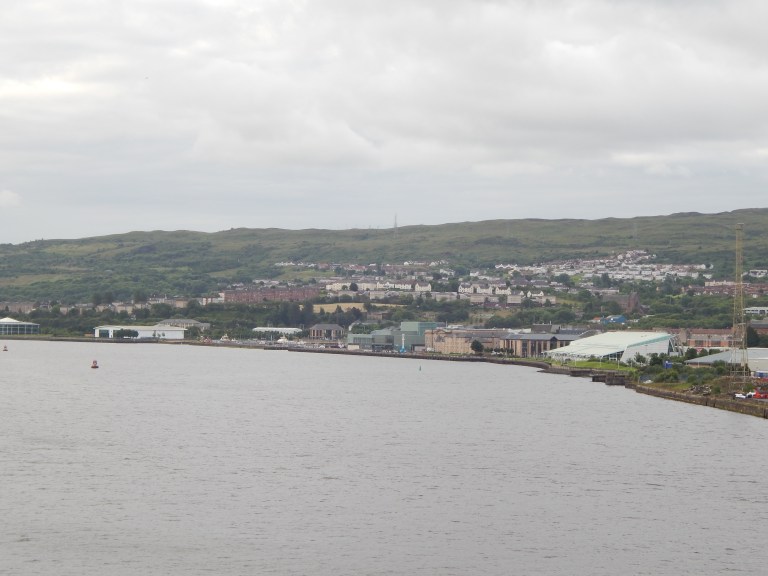
Leaving Greenock we crossed the firth over to Dumbarton, which is renowned as the birthplace of the legendary Scottish Formula 1 racing driver, Jackie Stewart. We headed up into the Scottish Highlands, our road eventually entering the Loch Lomond National Park, and drove towards the small village of Luss which is situated on the shores of Loch Lomond.
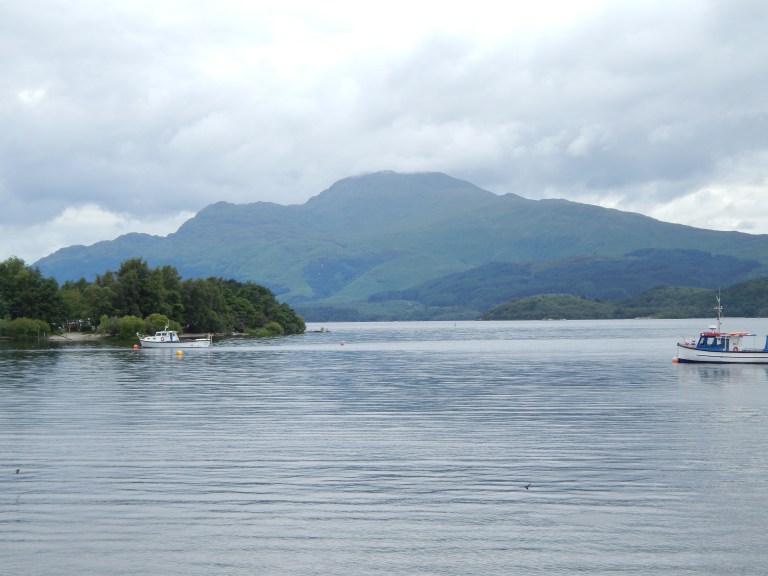
This village is just so pretty!! From here you get beautiful views of the lake, with stunning hills and mountains on the far shore, including Scotland’s highest mountain, Ben Lomond. Jenny of course went mad taking pictures – to the point where the camera actually started smoking with the effort! We calmed both Jenny and the camera down with a coffee (for Jenny, not the camera), and proceeded on the bus along the Loch to the lovely village of Tarbet, where we left Loch Lomond.


From there we travelled through some spectacular Scottish highland country – deep and beautiful valleys carved out by fast moving streams, and some of the most spectacular and beautiful countryside we have seen to date. At one point the bus paused at the head of the major valley to allow for photos, at the aptly named Rest and Be Thankful, but none are likely to match our vivid memories of this wild and beautiful country. Altogether we saw five Lochs on this trip: Loch Lomond, Loch Long, Loch Fyne, Loch Eck and Holy Loch.

We returned to the ship so glad that we had seen this magnificent country. Later in the afternoon, as the ship steamed out along the Firth of Clyde to make its way north and a day at sea tomorrow, we continued to marvel at the beautiful Scottish countryside, particularly the breathtaking Isle of Skye, that we could see from our cabin’s balcony.


Breathtaking … views of the Isle of Skye from the ship
Orkney Isle and Skara Brae
Our stop in the Orkney Islands and trip over to see Skara Brae was so special that we have written this up as a separate blog post. This beautiful island, which in World War Two hosted the famous naval base at Scapa Flow, and which five thousand years ago was home to resilient Neolithic communities, was truly a memorable experience. Please feel free to read that post if you are interested.
Loch Ness and Urquhart Castle
Having docked in the seaside town of Invergordon (famous for the magnificent street art which bedecks its buildings), we were booked on an afternoon bus tour to go to Loch Ness and Urquhart Castle, that iconic, ruined castle that you see on the edges of Loch Ness in so many photos. Unfortunately, we left the port in a light rain which diminished visibility a little, but there is no denying the beauty of the Scottish countryside, particularly when we got up into the wild, beautiful heather-strewn moors.
The loch and the castle were both spectacular, with the Loch suitably brooding, turgid and mysterious within its misty, rain-sodden bordering hills, and Steve felt sure that today would be the day that he spotted Nessie, the Loch Ness monster, and thereby put all the speculation to rest!


Urquhart Castle was apparently, for a long time, the place of power in the highlands and strategically very important. A scale reconstruction of the castle in the small museum there shows how large and self contained the castle complex was. As well as the usual things – defences, barracks, armoury, living and sleeping areas, kitchens, dungeons – it also had a theatre for public events and performances. Much of this is still discernible in the ruins, and it was great to be able to walk around them.
Returning to the ship on the bus we took a different route, along the length of the loch (Steve, much to Jenny’s amusement, desperate to see Nessie, but he didn’t, of course), and through the city of Inverness. This is quite a beautiful little city with a lot of character in its architecture, parks, old churches and old and new public buildings. A very enjoyable stop over.
Spectacular Edinburgh
As our final Scottish destination we spent a wonderful day in the spectacular Scottish capital city of Edinburgh. The ship anchored in the Firth of Forth at South Queensferry, about 25 minutes’ drive from central Edinburgh. We picked up a shuttle bus into town and were dropped off at Charlotte square, on which, we discovered, is situated the house of the current First Minister of Scotland, and also the previous house of the inventor of the telephone, Alexander Grahame Bell. Our bucket list was to visit the National Museum of Scotlandand see the special Celtic exhibition there; see the spectacular Royal Mile, the long main street and shopping centre of Edinburgh, and on the way to see Edinburgh Castle.
Set high up on a rocky outcrop, the Castle stands over the rest of Edinburgh like a sentinel. To we military novices, it looks like it would have been impossible to successfully attack this castle, standing as it does atop such high cliffs. We took a short cut through a wide, deep park at the base of the castle outcrop, only to find out that we were walking through the massive moat that once surrounded the castle. Spectacular indeed!


Two view of Edinburgh Castle: from the city (L), and from the ship at sunset (R)
The National Museum is easy to find, located in a vast cultural precinct which includes the national art gallery and the national library. Outside, it looked like any other public building. Inside, it was completely unexpected – wonderfully designed, centred on a large, glassy atrium, full of light, mezzanines, and space. The exhibitions ranged from titles like Kingdom of the Scots, Technology by Design and Scotland Transformed, and included working robots, three Formula 1 racing cars, an amazing overview of the works of Scottish innovators, a working miniature hot air balloon that people could manipulate, as well as extraordinarily well constructed exhibitions on the political, social and cultural history and development of Scotland.
The Celtic exhibition, simply titled Celts, was organised with the British Museum in London, and contains a wonderful array of Celtic arts and jewellery and artefacts of life from ancient, pre-Roman, and Roman Britain. It has been described by the various leading British newspapers as stupendous, stunning and staggering, and it certainly was. In organising its displays it explains how Celtic cultures were not confined to Britain, but were part of an expansive integrated cultural and trading network, evidence of which has been found in modern France, Germany and Spain, and as far east as Iran, as well of course in Scotland, Ireland, England and Wales. We spent a long time taking it all in. It was fantastic.


Leaving the Museum, we set off for the Royal Mile. The streetscape on the Mile was spectacular, with old, brown sandstone 18thand 19thcentury buildings stretching as far as the eye could see. And crowded! Being a Saturday, a large section of the street was closed off for markets, buskers and artists, and thick crowds surged along all parts of the street. Having marvelled at this, and at the way suicidal pedestrians take on moving traffic in the city of Edinburgh, we made our way back to the bus and the ship.
Le Havre, France
For many on our ship, docking in Le Havre this morning gave them the opportunity to take a bus tour into Paris and see the sights. At 195 km each way to Paris, this represented a very long trip and not too much time to spend in Paris. As we had been to Paris on three other occasions, we decided not to rush a trip to focus on seeing Le Havre, where we had not been before.
This port is in the middle of the stretch of French coastline where the D-Day invasion landings took place in 1944. It was decimated by bombing during the war, and the city’s commercial, residential and government centre was rebuilt in a (then) ultra modern style after WWII under the auspices of a Belgian architect, Auguste Perret. This large area of redevelopment, now over 60 years old, was listed in 2005 on UNESCO’s World Heritage list. So it has an unusually modern and consistent look and feel for a European city’s CBD.
We firstly walked to Saint-Joseph Church, designed in a brutalist modern style by Perret and built between 1951 and 1957 (completed after his death). This is amazing, built from large, pre-cast concrete blocks and girders, with a vast open space in its main chamber. Its magnificent, crowning feature is a 110 metre octagonal-shaped tower into which is also built a lighthouse beam at the very top (useful in a port city), and into which is inlaid 12,768 coloured glass pieces, which from the inside gives a magnificent rainbow effect in the daylight. This building dominates the city’s skyline, and is an amazing thing to see, inside and out.


Secondly, we visited the MUMA, Le Havre’s Museum of Modern Art, which is highly regarded for having on display many works of the French impressionist painters of the 1870s-1920s, particularly the work of Eugene Boudin. It was good, but not great, based as it was on a vast collection of Boudin’s paintings of seascapes and port scenes, and farming and beach scenes. MUMA also has a couple each of Pissarros, Monetsand Renoirs, along with works from some other contemporaries.
We thoroughly enjoyed this cruise around the British Isles – it gave us a nice taster of places we would like to visit again in more depth.
 Adventures for Two