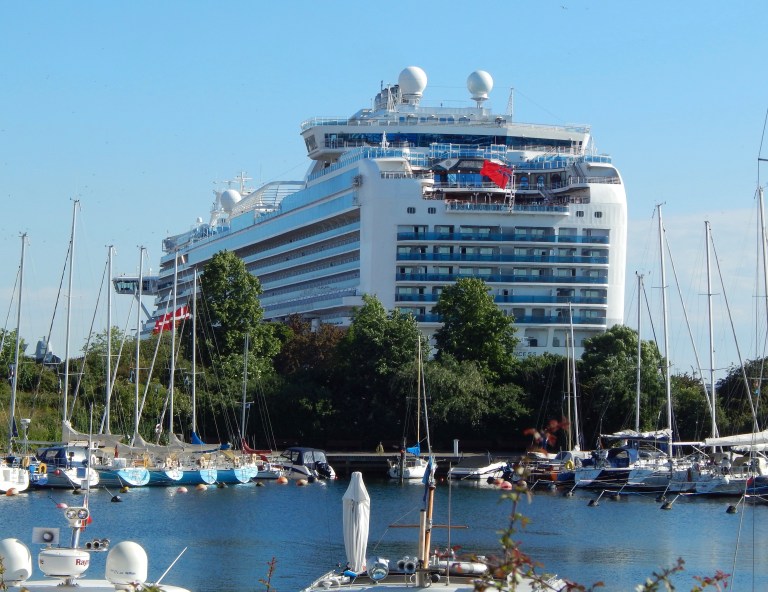
A great way to sample key places in a limited time is by taking a cruise, and that is what we did on this trip which we took took in 2016. Never having been to the Baltic region, we booked on the Emerald Princess, quite a large cruise ship. It has 19 levels (stories) that we could access, and it carries something like 3000 passengers and 1200 crew. It features many shops, restaurants and cafes, bars and clubs, swimming pools, a medical centre, a beauty/relaxation spa, a very large theatre, an art gallery, a casino, a 9 hole golf putting course, a running track, and many hundreds of ‘staterooms’ (cabins, in the old days). Here is a link to information about the ship if you’re interested: princess.com, and here is a photo of the ship that we took in Copenhagen, the capital of Denmark, on the way north to St Petersburg.
‘Venice of the North’ – Bruges in Belgium
Our first port of call out of Southampton was Zeebrugge, a working port in Belgium, from where we went by bus into Bruge, a very pretty little medieval town which, because it is set on a grid of canals, is often called the ‘Venice of the North’. Highlights of this stop, on what was a beautiful sunny day, were a walking tour of the city (which is famous for its Belgian chocolate and beer), and having the luxury of sitting in a café at the edge of the vast city square, having lunch and a wine, and watching the world go by. Apart from having to keep a wary eye out for the horse drawn carriages and cyclists which speed everywhere through the city, it was a very relaxed and enjoyable day. We decided we would like to see more of Belgium.


Copenhagen– Pickled Herring and Hamlet’s Ghost!
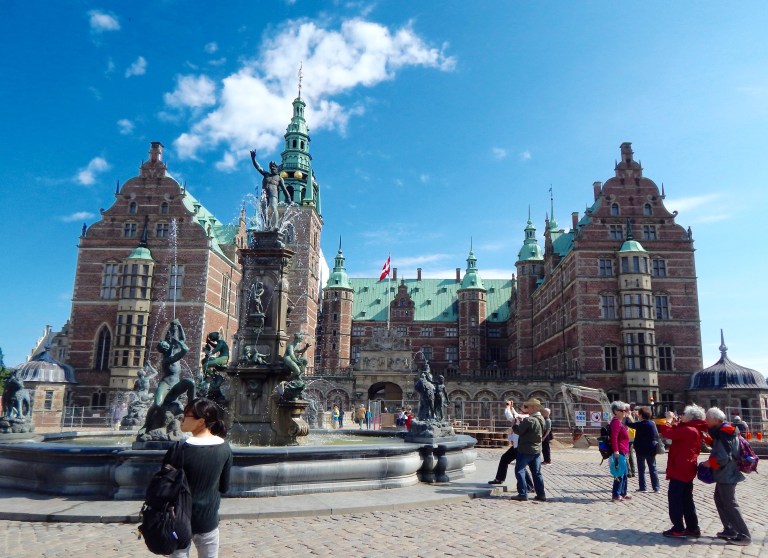
Our tour in Copenhagen, Denmark was to go one hour north of Copenhagen into the area of North Zealandto see Kronborg Castle, the site of Shakespeare’s play, Hamlet. Along the way we stopped at two other royal castles, Frederiksborgand Fredensborg, and stopped along the way at a very old Danish inn (1640s) where we were served a traditional Danish lunch. Travelling through the city we couldn’t get over the number of people riding bicycles. Our guide informed us that 45% of personal transport undertaken in Denmark is undertaken by bicycle – the government has made a considerable investment in bike paths and lanes, and in linking cycling to railway infrastructure. Further out from the city the scenery is lovely, with many wooded areas and agricultural fields abounding.
First stop, Frederiksborg Castle. This is a huge, magnificent building considered to be a superb example of Dutch Renaissance architecture. Here we saw an abundance of royal and princely portraits (literally covering every square metre of wall – we’re pretty sure no Dutch or Danish artist could have been unemployed in the 17thand 18thcenturies), the world’s oldest wooden pipe organ (still giving concerts every Thursday), and an astounding array of period furniture, clocks and jewellery. Frederiksborg is also the site of Denmark’s National Portrait Gallery, and we were able to view a wonderful exhibition by Jonathan Yeo.
Then, lunch! There was so much food, supplied by our very friendly hosts, that we couldn’t eat it all. We were offered traditional Danish beer, followed by the first course – rye bread, two types of pickled herring and crumbed flounder accompanied by a delicious sauce. The second course consisted of other traditional Danish fare – Danish meatballs, bacon, pork steaks, pate and cheese, all served with rye and white bread. Finally, coffee!
Struggling back to the bus we drove on and parked just across from Fredensborg castle, the winter home of the current Queen of Denmark and Queen’s Consort – no tour here, just a few photos if you wanted them. Then, on another 20kms to the main event – Kronborg Castle. Our tour guide explained that Kronborg opened, to great fanfare and celebration, in the early 1600s (1603?) and that, at the time, it was a huge event over Europe which attracted many visitors. Among these were English actors who performed at the opening, and the theory is that they returned to England and told Shakespeare about this magnificent new castle. Shakespeare, who was writing Hamlet at the time, decided to situate his play at Kronborg. There are other elements to this theory, but that will do for now.


The castle had cleverly piggybacked on the 400th anniversary of Shakespeare’s death to conduct unique tours of Kronberg Castle. Actors, portraying characters from Hamlet, acted out scenes in the courtyard (we saw Ophelia arguing with her father), appear randomly during tours, and even conduct tour groups. Our tour was led by Horatio, who took us from room to room as an informed witness to the events which had recently unfolded in the castle, leading to the deaths of Hamlet’s father, the King, and finally to the death of Hamlet himself. A very enjoyable tour, very imaginatively done.
What a ship! What a treasure! – Stockholm, Sweden
Here we docked at the port of Nynashamn and travelled to Stockholm by bus. It was cold – about 10 degrees centigrade as we set out at 8.30am. The 45 minute bus trip was interesting, revealing a very green land under crop, many horses along the way, and many, many pine plantations. Stockholm, as it turns out, was founded in 1252 and is situated on 14 different islands. It has an older part of the city, Gamla Stan, which we visited, along with the genteel architecture and parks of nineteenth century affluence in the wealthier parts of the city, and the steel, concrete and glass and bustling vibe of modernity.
Gamla Stan, the oldest part of the city, was fascinating with its cobblestoned streets and narrow, square-fronted attached houses. We saw glimpses of lush gardens at the rear of some of these houses. Over the course of a year, Swedes get relatively limited opportunities to relax in the warm sun, and take every opportunity to get outdoors – even in city gardens! Later, in our ‘free time’, we had an enjoyable lunch at one of the cafes in Gamla Stan.


This was a highlight for us. The Vasa is a magnificent, fully intact, 17thcentury war ship commissioned by Gustavus II Adolphus, the King of Sweden at the time. It was to be the largest of Sweden’s naval vessels and flagship of the fleet. The problem is it sank 15 MINUTES (and 1300 metres sailed) after launch, in 30 metres of water, with the loss of 50 lives, because it was top heavy with too many cannon decks.
The Vasa lay, on its side and forgotten for 300 years until the 1950s, when a Swedish archaeologist and researcher managed to discover its location at the bottom of the bay. It was in remarkable condition – indeed it was whole, preserved by the cold water. It took five years to carefully raise the ship with cables, another 17 years to prepare and protect the timbers for display in the open air, and a couple more years to build its own museum – the Vasa Museum – around it. So there it now sits in Stockholm, magnificent, a national treasure, and hugely popular with locals and tourists alike. It is the world’s oldest, fully intact sailing vessel, and in such good condition that when they finally raised it from the bottom 60 years ago, they were able to float it into shore!
To conclude our day we visited the Nobel Museum which fronts onto one of the squares in Gamla Stan. The Museum is small, but SO interesting. Through interactive media you can research the winners of any of the five prizes – in Physics, Chemistry, Medicine, Literature, and Peace – right back to the inception of the prize in 1901. A highly recommended visit.
Tallinn, Estonia
Here, on a very rainy day, the first visit was to the Photo Museum in the Town Council’s Prison. Admittedly, the initial attraction was that it was out of the rain, but it proved to be surprisingly interesting. The museum is located in a late-Gothic building erected at the end of the 14thcentury as the town prison. It’s had a few minor alterations since, but basically today looks as it did after the restorations of 1441-42. The lime-washed stone walls, low ceilings and narrow winding stairways certainly retain the ambiance of a mediaeval prison, and many of the sepia photographs are ghostly images of people long passed.
Next, braving the elements again, an uphill walk over cobblestone streets (what else!) led to the quite impressive Alexander Nevsky Cathedral. This Russian Orthodox church is, not surprisingly, very Russian in appearance with its colourful façade and tiled domes. The Old Town Hall Square, much smaller than its name implies (and easy to miss unless you were really looking for it!), was the site of the first publically displayed Christmas tree in 1441. The custom then was to dance around the tree, then burn it after the celebrations were complete, so not too much has changed. Overall, the Old Town of Tallinn lives up to its UNESCO World Heritage status. Its narrow streets and laneways don’t seem to have changed much over the years, numerous market stalls still hug the old town walls which date from 1265. Actually, some of the knitted hats for sale probably haven’t changed in all that time!
Old, Gold, Cold St Petersburg
We spent two cold but wonderful days in St Petersburg, Russia, where there have been many highlights. Here, we had decided to hire a car, driver and our very own guide, Olga, who as a child grew up in northern Siberia before she came to St Petersburg in 2001 to study at university. We firstly toured the city by car, looking at its ‘old centre’ dominated by Dutch-inspired late 18thcentury neoclassical streetscapes, and its many rivers and bridges, then a quick look inside St Nicholas Cathedral, which was beautifully decorated in wood on the inside, and gilded (gold laid) stone and metal on the outside.
The Hermitage, now the premier museum in St Petersburg and one of the great museums of the world, is huge, with innumerable richly decorated and designed rooms containing 300,000 pieces of art (the other 2.7 million works held by the Hermitageare not on display at any one time). We saw Da Vincis, a Michelangelo, a series of Rembrandts and a Titian amongst the huge number of works on display. Stunning! In our adjacent tour of the Winter Palacewe also saw the exact spot on the back stairs where communist fighters overran troops loyal to the Tsar in 1917, thereby triggering the Russian revolution.


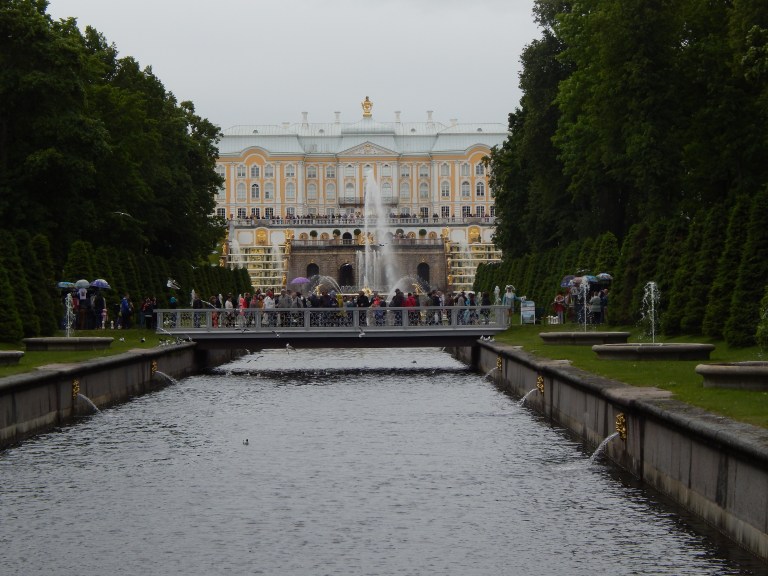
We also visited The Peterhof Palace, designed in 1708 to be a slightly smaller version of the Palace of Versailles in Paris. We travelled there by hydrofoil ferry (greeted on arrival by a strong, cold north-westerly gale straight off the Baltic), and toured the beautiful 64 hectares of gardens and the separate Empress’s bathhouse, which is now a museum. The gardens contain 124 different fountains, some incredibly modern in design, through which water flows by gravity alone. All of this was just on our first day!
At the beginning of our second day in St Petersburg we visited the Russian Museum which contained some fascinating pieces, beginning with 12thcentury religious iconography with distinct Byzantine traditions, to the first Renaissance influences on Russian art, to more contemporary pieces influenced by impressionism, abstraction and social realism under the communists. Following this we went with Olga to have a lunch of potato and mushroom pancakes and pickles, a traditional Russian lunch, we were told (most delicious).
We then visited the Cathedral of the Spilled Blood, right next door to the Russian Museum. This is a relatively young building, built in the early 1900s to commemorate the spot where Tsar Alexander 2nd was assassinated in 1881 by Bolshevik terrorists. Within the building they have maintained the part of the cobblestoned street where Alexander died after being felled by a bomb. It is an incredible building, made from many different types of marble, with the walls and ceiling surfaces covered with fine mosaics. And, as is usual in Russia, it has much rich, gilded trimming. Olga told us that under the communists, (who saw religion as an enemy of communism), this extraordinary building was unbelievably set down to be demolished in 1941 under Stalin’s 5 year plan, but was saved when Hitler invaded Russia that year. Its massive dome took a hit from a bomb in the war, but it failed to explode, and spent the next 20 years sitting on its side on top of the dome before it was taken away and detonated! Now, the building is a museum of mosaics, and is a major attraction in the city.


In the afternoon we took as our final destination in St Petersburg a long-anticipated and enjoyable visit to the Errata Museum– a private art gallery and the only contemporary art museum in Russia, according to Olga, although there are plans to build more. This museum is situated in a more modern part of the city, and interestingly, many young Russians were here and were clearly interested to experience contemporary pieces as a relief from the Russian (official) preoccupation with historical and conservative art. This contained quite a few stunning and powerful pieces, which provided a small window into the way contemporary artists view the Russian soul and society. Olga was a fantastic guide and conversationalist, and we learned a lot about the city, and the nation, during our time with her in St Petersburg.
Fabulous Finland
Our next top was Finland. We spent a little time in Helsinki, Finland’s capital, before moving north out into the country to see a wonderful farm and the very old and quaint, but very important in the history of Finland, village of Porvoo.
The Finns are a proud people if our tour bus guide today, Irro, is any indication. They are proud of their world renowned composer of music, Sibelius, their Formula 1 motor racing world champions and their skiing and ski jumping Olympic and world champions. They are also proud of how Finland, after centuries of being ruled by Sweden and then Russia, boldly declared independence as a republic in 1917 and has, against significant odds, remained independent ever since.
And they are right to be proud. From what we saw in our one day here, it is a fabulous, beautiful country. And we were only in the south – not in the centre, with its beautiful lakes and dairy farms, and not in the far north, in Lapland, with its vast tracts of snow and ice, its reindeer, its nomadic herders and the home of Santa Claus (according to Irro).
Helsinki itself is a lovely, smallish city with a very relaxed and urbane feel to it. Many bicycles (very Scandinavian, we have discovered). Beautiful streetscapes. Lovely old and elegant buildings on the harbour. And, unlike many cities, they never got rid of their trams only to now re-value them – here, they kept their trams all along!


Moving out into the country we saw beautiful green fields under crop, and thick forests of pine, beech and fir trees, fenced against the highways to stop the wild elk from being struck by traffic. The farm we visited had been farmed since the 1450s, and currently four generations of the family – 27 people in all (with a further addition due that week) – lived on the farm in a variety of dwellings spread across the property. The farm is famous for producing horses for carriage driving competitions – apparently requiring greatly skilled horse and driver combinations. On arrival we were greeted with a morning tea of juices and cakes, all made from berries collected from the forests on the farm. A wonderful experience!


We then moved on to Porvoo, a smallish village on the river. The old part of town has wonderful, quaint old wooden buildings, narrow cobbled streets, an impressive Lutheran church high on the hill (in which we heard an impressive organ recital from a woman who just happened to be practising at the time), and lovely markets and coffee shops. We spent a lovely, relaxing hour there strolling about in the sun (and consuming one of the best, freshest strawberry smoothies ever!) before returning to Helsinki and the ship.
Poland– the beginning of the end of the ‘Iron Curtain’
Our final shore destination and shore excursion on this cruise was the amazing city of Gdansk in Poland. Docking in the city of Gydnia, we went by bus through three interconnecting cities – Gydnia, Sopot and finally Gdansk. The highlight of the trip was our visit to the Gdansk shipyard – the Lenin Shipyard– which saw the emergence of the Solidarity Union movement in communist Poland in the 1980s and, from this, the eventual emergence of democracy in Poland, the subsequent fall of the Berlin wall between east and west Berlin in 1989, and the ultimate fall of the ‘Iron Curtain’ across eastern Europe during the 1990s as we witnessed the demise of 50 years of communist regimes in Europe.
The birth of the democratic movement in communist Europe initially occurred due to the emergence of the Solidarity union movement in Gdansk in the 1980s and the subsequent protests which occurred as thousands of workers in the Lenin Shipyard fought for their rights and conditions. All of these events are captured and commemorated in the ‘Roads to Freedom’ exhibition in the Solidarity Museum in Gdansk.
The exhibition is stunning. It contains many artefacts from the struggle – videos of the strikes by 80,000 shipyard workers, speeches and meetings between unionists and government, the crowds massing in the streets; workers’ tools, hard hats, lockers, and the huge iron shipyard gates mangled and destroyed by government tanks in their attempts to break up the strikes; accounts from and the arrest warrants of some of the 3,000 workers who were arrested for their dissent; reconstructions of the gaol cells in which they were kept; so many photos of the strikes, blockades, efforts by the government to destroy the movement, and the joy of the mass of workers and the population at large as each small victory was won by the Solidarity leaders and celebrated by the population. All these artefacts, housed in a huge, stark, industrial scale museum resembling a rusting ship’s carcass under construction, alongside a soaring memorial constructed at the place where three striking ship builders were killed by police when they fired upon a strikers’ march.


We emerged from the museum feeling admiration and awe at the skill and tenacity of the people of Gdansk and in wider Poland, and their determination and courage to fight for their freedom. Truly recommended as a place to visit.
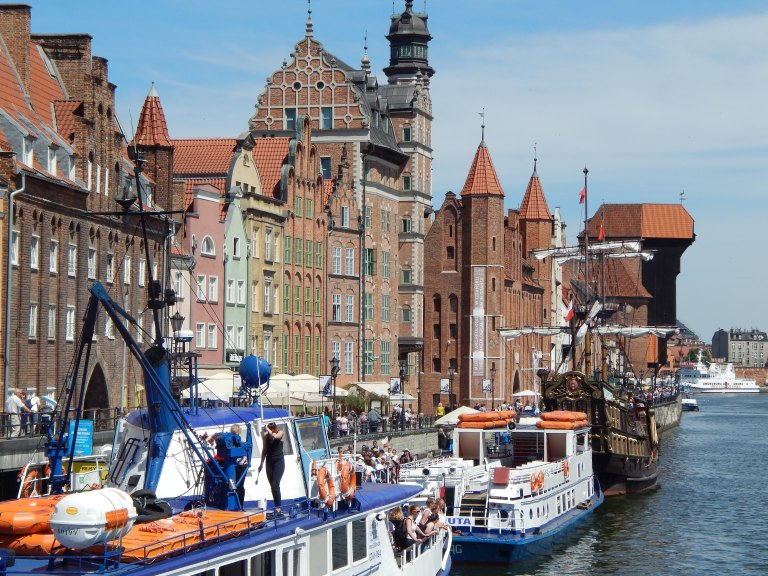
And yet Gdansk also displayed a softer side – the beautiful, main ‘royal street’ stretching from the Green Gate, which we walked through, down this amazing, wide cobblestoned street bordered on each side by the most extraordinary reconstructed, beautifully adorned medieval houses (many were destroyed in WW2), past the Neptune’s fountain constructed in 1615, then down to the Golden Gate at the other end, a wonderful 16thcentury arch. We had our morning tea on this street, in the sun on the street’s edge watching the world go by (Steve, home made apple pie, ice cream and the best fresh raspberries ever!!; and Jenny, beautiful pancakes with maple syrup and fresh strawberries – both accompanied by a lovely coffee). Then, back to Gydnia and the ship.
Following this we had two days at sea before disembarking in Southampton. We thoroughly enjoyed our sea tour and shore excursions through northern Europe and Scandinavia, a place where we had not been before and which is really worth visiting for its history and its lessons on life. The Emerald Princess was an excellent base during our two weeks on board.
 Adventures for Two