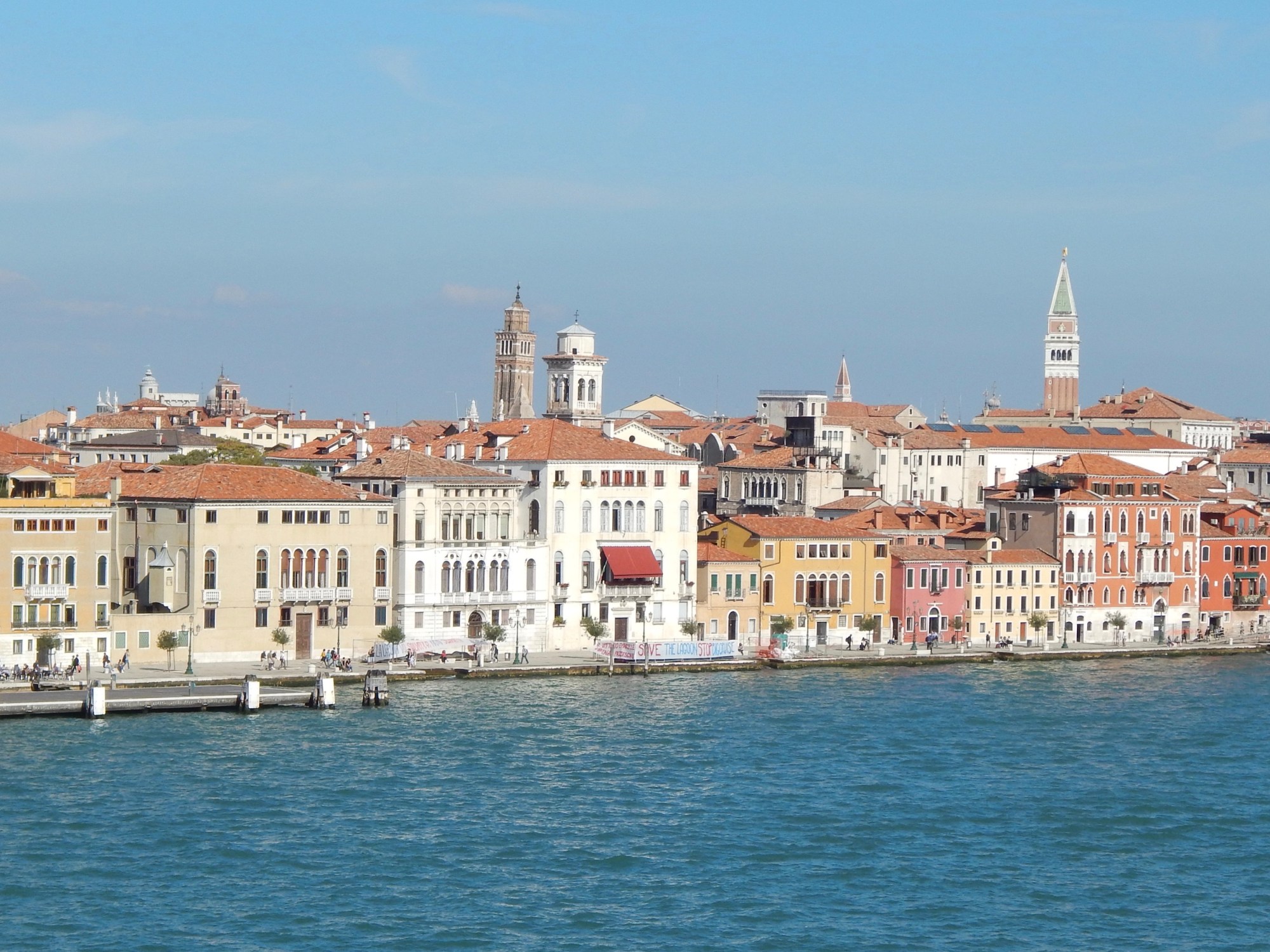
This was the second trip we took on the ship the Aegean Odyssey, part of our wonderful Voyages to Antiquity tour. We made this journey in September 2015.
Greece
Your can read about our earlier experiences in Greece in our Istanbul to Athens post. From Athens we continued west to the port of Gythion, near the ancient city of Sparta, which still exists as a modern town. Just out of Sparta is the extraordinary Byzantine hillside stronghold of Mystras, sprawling across the slopes of Taygetos Mountain. It was quite a climb to reach this once 20,000 strong community, which was established in 1249 AD and flourished for over two centuries, but certainly worth the effort. Perhaps the most fascinating aspect of Mystras is the many paintings still adorning the walls and ceilings of the churches. Although few are intact, and most have faded considerably with age, it isn’t difficult to imagine how impressive these must have been in their prime. From the many ruins perched at various points on the hillside, the views of the surrounding countryside were stunning.


Our ship was forced to miss Ithica due to thunderstorms, but we did have a wonderful tour of the site of ancient Olympia. We were lucky enough to be in the first tour of the day, which meant that we were able (to some extent at least!) to avoid the vast crowds that descended on Olympia from several cruise ships much larger than ours. This site looks serene in the early morning light, and it wasn’t difficult to imagine those long-ago inhabitants walking the avenues. Our visit included walking through the remains of the entrance gate to the ancient arena, and standing on the finish line of that famous running track. We also saw the place where the Olympic flame is lit every four years (though our quite left-leaning and delightful tour guide, Georges, took great delight in pointing out that the flame ceremony was not used in the ancient Olympics and was first invented by Adolf Hitler for the 1936 Olympics). After wandering the ruins, we spent a leisurely hour browsing the Archaeological Museum of Olympia, which houses many of the treasures reclaimed from the site. Another box ticked on the bucket list!


Leaving Olympia we went to Corfu, which because of its strategic location between the Ionian and Aegean seas has been occupied by many countries over the centuries. We visited an amazing fort constructed by the Venetians in the 1200s (they occupied Corfu from 1200 to 1600 – the British later occupied and built a cricket pitch which still sits there in the middle of Corfu, amongst other many other neoclassical Greek type buildings also built by the British). We finished off by having a wonderful coffee and apple pie for morning tea, right on the water, in a little cafe not yet discovered by the hordes of other tourists beginning to flood into the town. Very serene. And that was our final stop in Greece.


Albania
Believe it or not we spent only 6 hours in Albania, the ship having steamed the 10 kilometres across the bay from Corfu and having docked in the Albanian port town of Sarande. But, this was perhaps the best 6 hours of the tour so far as we went inland to a very pretty site set amongst lakes and hills – the ancient, UNESCO World Heritage site of Butrint. This was originally an Hellenic Greek colony, and then a sizeable and beautiful Roman city grafted onto, and expanded upon the original Hellenic structures.


Butrint then became a prosperous Byzantine town in the very early Middle Ages (the supposed ‘Dark Ages’ of western European history), and then a Venetian town up until the later Middle Ages, when it was abandoned due to incessant flooding (still evident today). Everything in this site, right back to the Ancient Greek period, is just so incredibly intact and well-preserved, and you can see how the city developed in stages and continued to utilise and develop the earlier infrastructure. Butrint was a very strong highlight of this journey for us.


Croatia
Our engagement with Croatia actually came in the middle of our ports of call in Italy (see below). From Albania we sailed across the Adriatic Sea to the Italian port town of Brindisi (where we stayed on board the ship and took a rest day!), from which we then sailed back up the Adriatic, north east, to the medieval, walled port city of Dubrovnik. From our ship’s dock we were able to admire the new Franjo Tudman Bridgeat the mouth of Rijeka Dubrovacka, before heading off to the walled city of old Dubrovnik. We didn’t take a tour on this day, instead choosing to walk through the old town and take in the ambience and stunning medieval cityscape of this tourist-friendly and urbane European city. Arriving early to avoid the inevitable crowds of tourists (like us!), we strolled through the cloister of the Franciscan Church and Monastery built in the 14thcentury, and walked the long main street (Placa, orStradun) that runs from the Pile Gate to the harbour. Feeling somewhat tired of yet more old buildings, Steve returned to our meeting point outside the old town, while Jenny made a valiant attempt to walk the old city walls. Unfortunately though her fear of heights got the better of her yet again, and she only managed to walk part way around. Oh well, maybe next time!


Split, in Croatia, was unlike most of the other sites we visited. Here, instead of the ruins of ancient cities being preserved, frozen in time, in Split the remains of the imposing Palace of Diocletian (305 AD) form the backbone of the modern city. Everywhere you look in the heart of the city, ancient walls, columns and ceilings have been integrated with modern architecture so that the life of this old city continues unabated. A walking tour took us under the city walls and through the old city, past the Cathedral of Saint Domnius (its octagonal building was originally the mausoleum of Diocletian, and its soaring bell tower was added in the 12thcentury), to the City Museum of Split. We were lucky enough to be just at the right time to catch an impromptu performance by a group of tenors, their voices taking full advantage of the brilliant acoustics of an old courtyard.
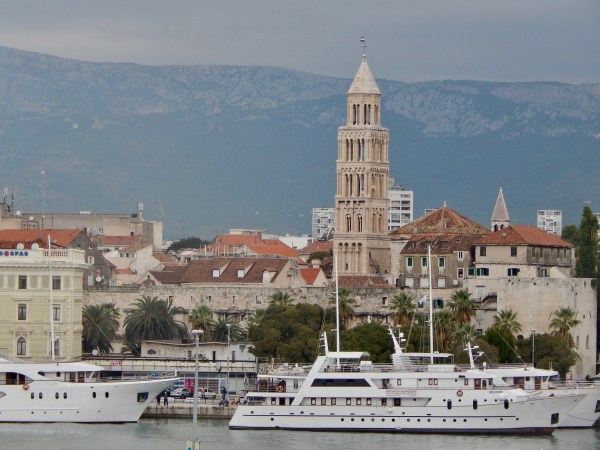


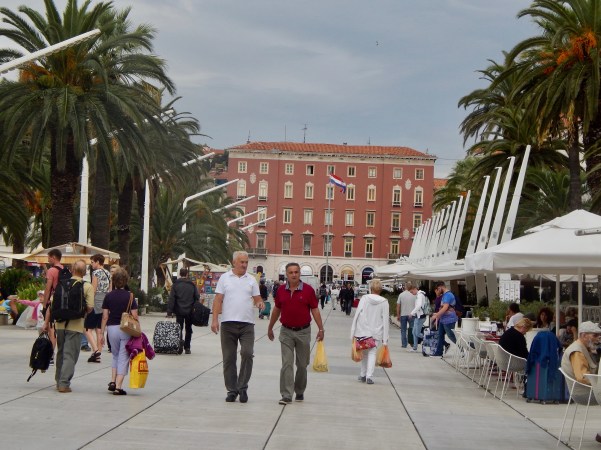
Venturing just outside the walls of the old Palace, we visited the Split Gallery of Fine Arts. Here, the rich cultural heritage of Croatia was on display, from early times right through to the modern day. It was a pleasant change, in some ways, to spend time admiring the skills and talents of today’s artists. Returning to the old city, we roamed the streets, marvelling at the myriad of shops, bars, cafes, hotels and galleries found in, on and even under the white stone walls. We spent a very pleasant hour sitting under one of the massive shade canopies on the Riva promenade, sipping our coffee and watching the hordes of tourists passing by.
Italy
From the port of Ancona, a scenic bus journey brought us to the beautiful and historic hilltop town of Urbino. Urbino’s main claim to fame is its legacy of Renaissance culture, particularly that of Federico da Montefeltro, Duke of Urbino from 1444 to 1482. The highlights of our day here included a tour of the Palazzo Ducale, which now houses an art museum grandly named the Galleria Nazionale Delle Marche, and a very interesting visit to the childhood home of the artist Raphael (1483-1520). It is impossible to convey in a few words the extent of the riches on display in the palace, not only in the art works dating back to the 13th and 14th centuries, but in the architecture and decorations of the palace itself. In contrast, the simplicity of Raphael’s home gave a sense of what life was like for the less wealthy inhabitants of Urbino. Many of Raphael’s most famous works now live in the Vatican, but the good folk of Urbino are working to have at least some of the treasures returned home.


Urbino streetscapes and hinterland views
The town is home to the University of Urbino, founded in 1506, and is one of the most popular university towns in Italy. No wonder! Who wouldn’t be inspired studying amongst such historic grandeur? After a leisurely lunch in one of the many al fresco restaurants, we roamed the cobbled streets enjoying the architecture and the atmosphere, as well as glimpsing views of the surrounding countryside between the old buildings. As we drove back to Ancona and our ship, we marvelled at the many hilltop villages, all with the obligatory stone buildings dating back hundreds of years. When one of our fellow passengers enquired about the name of a particularly impressive edifice on a nearby hilltop, out knowledgeable guide promptly identified it as ‘JABC’ – Just Another Boring Church!
Our final port on this wonderful journey was Venice. Having visited Venice once before, we elected to forego the organised walking tour, and went instead to the Doge’s Palace (Palazzo Ducale). How glad we were that we did! The Doge’s (Duke’s) Palace is one of the most impressive sights we’ve seen anywhere on our travels. Although the palace itself has undergone many, many changes over the centuries, it retains much of its original structure and features, and is perhaps the most ornately decorated place we’ve ever seen. It is testament to the almost unimaginable wealth of the early Venetian dukes.


Views of Amazing Venice
As part of our Voyages to Antiquity cruise, a special visit to St Mark’s Basilica (Basilica di San Marco) had been organised for us. Instead of queuing in the Piazza San Marcoalong with the thousands of other tourists waiting to enter each day, our group of approximately 300 people were treated to an exclusive evening visit. After crossing the Grand Canal from our hotel, we all traipsed into the Basilica in awe and took our seats. The lights were promptly turned off and we sat in complete darkness for a few moments until, one by one, the lights came on at strategic intervals, gradually illuminating the magnificent gold ground mosaics covering the ceilings and upper walls. After some time spent simply admiring the sight, we were able to tour the Basilica (without fighting the crowds). The 12th century marble tessellated floors have undergone many restorations over the years, but remain essentially as they were. Walking around the interior, the undulations in the floor are unmistakeable, and remind visitors that they’re essentially walking on water (courtesy of thousands of wood pilings driven into the mud of the lagoons). Venice is a magical city, well worth a visit, but its popularity as a tourist destination hasn’t served it well. Many of today’s Venetians would much prefer the tourists all stayed home!


Having completed our Voyages to Antiquity tour we stayed on in Venice for a few more days to enjoy the Venice Biennale. Apart from the main Biennale site, with its vastly differing individual pavilions, we visited a number of other exhibitions and galleries. Finding our way around and over the many canals was sometimes a challenge, but all part of the adventure. We particularly loved the Peggy Guggenheim Collection, housed in a beautiful palazzo which was the home of the American heiress Peggy Guggenheim.
To complete our wonderful trip, and to rest up for a few days prior to the long journey home, we took a train to Verona. While much of our stay was marred by rain, we enjoyed the more relaxed atmosphere and the less-crowded streets of this charming town. We rented an apartment near the town centre, and lived like true Italian locals, for a few days at least!


Our final destination: the city of Verona, and our accommodation
 Adventures for Two