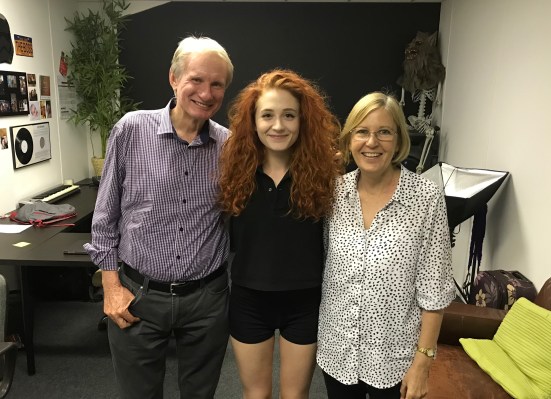
Apart from spending a little time in Ireland several years ago while visiting from a cruise ship (see previous post on cruising the British Isles), this has been our first time visiting Ireland. We came here from London where we had a very low-key stay this time, staying near Marylebone station, immersing ourselves in the local community, and not doing the sightseeing stuff (we discovered that we had already done the ’10 top things to do in London’). We did stroll through Regents Park and the Church Street markets. Our highlights were having lunch one Saturday with Steve’s niece and her partner and their adorable dog Teddy; and being invited to watch live the online show of our favourite Irish singer, Janet Devlin, as she performed her monthly shows on Stageit.com from a studio a short train trip out of London (we had only watched these online before). She was unbelievable live: she is so engaging with her audience, and she has an extraordinary and beautiful voice. Janet said she hoped we would have a great time travelling in her motherland of Ireland, and as it turns out, we really did!
Apart from wanting to get to know a beautiful country, a strong motivation to visit this country is because so much of Jenny’s ancestry, and some of Steve’s as well, is embedded in parts of Ireland we are visiting. Given this, we flew from Heathrow into Shannon airport, picked up our hire car, and proceeded north to the town of Ennis, in County Clare, where we would stay the first two nights. Here we stayed in a very old and historic pub, the Old Ground Hotel, parts of which, as well as being a hotel in the past, have also been a jail and the town hall. The town centre of Ennis reminded us of village centres on the continent, with their narrow, winding streets, small and colourfully painted shops and buildings, and loads of character. The hotel was beside the Cathedral, which rang its bell each hour, but which thankfully ceased at 9 pm, allowing nearby residents to get some sleep!
While staying at Ennis we did the half hour drive on a rainy morning to Lehinch, on the coast, to see the wild Atlantic waves assaulting the shore and marvelling at the fact that there were surfers, and a local surf school, fully active. Unfortunately here, as in much of our time in Ireland, the rain prevented us from taking photos that do justice to the stunning landscapes. In Ennis we also visited the local museum and enjoyed the various sculptures located about the village. We ate several meals in The Poet’s Corner, the lively pub which comprised part of our hotel, and also, given we had once eaten in an Irish pub in Rome, on our last night in Ennis we sampled delicious pasta and the house wine in a small Italian restaurant nearby the hotel.


Views of Ennis, Co. Clare
Following Ennis we made our way south to the village of Adare, but what a drive it was along the way! We firstly headed east to the village of Scarriff, which is where Jenny’s three times great-grandmother, Mary Hasitt Ryan, died in the local workhouse in the 1850s. This was the time of the Irish famine, a compelling exhibition on which we saw later during our stay in Dublin. The Famine led to the deaths of millions, decimating the population of Ireland and also causing huge waves of emigration from the country to destinations such as the United States, Canada, Australia, New Zealand and South Africa. The British overlords in Ireland were generally unsympathetic to the plight of the Irish in this time, consolidating the hatred many Irish felt, then and later on, towards British rule.
Not much of the workhouse at Scarriff remains, but we were able to visit the remaining buildings there, and also a local memorial park, An Casaoireach, which was established in the 1990s outside of the town. Here there is a mass grave that was created in the 1850s for the people of the workhouse who had died of disease and starvation, and it is here where Jenny’s ancestor is presumably buried along with 7,000 estimated others. It is now a place of natural grasses and mature trees, a quiet and sombre place. It was clear that others had been there before us to reflect and pay homage to these poor unfortunate souls who were caught up in a brutal and unforgiving society and time in history; a terrible time, and we are glad to have gone there to acknowledge their suffering and for Jenny to connect with Mary Ryan.


This very sad story of Jenny’s ancestor has a silver lining to it. Mary Ryan’s young daughter, also Mary Ryan, was fortunate to receive an education in the school established in the workhouse. Although her mother was still alive and living in the workhouse at Scarriff at the time, 17-year-old Mary was chosen as one of the 4000 Earl Grey Scheme “famine orphans” who were given free passage to Australia to work as farm or domestic servants and (hopefully) become the wives and mothers the colony desperately needed. Thus, Jenny’s great great Grandmother fortuitously found her way to Sydney, eventually marrying an Irishman, Stephen Toohey (son of an Irish convict), and raising thirteen children. Mary and Stephen Toohey lived in Gunning near Yass, NSW, where Mary died in 1899 at the age of 67.


We travelled from Scarriff, in a roundabout way, through some lovely country – firstly to Mountshannon, on the shores of the beautiful Lough Derg; then south along the lough (lake) and through Killaloe and Ballina and then down the M7 and M20 into County Limerick, and on to Adare. Here we stayed for two nights, in Adare Manor. Jenny says that everyone should stay in a five star castle once in their lives, and that is what Adare Manor is. Set on a beautiful 800 acres on the River Maigue, and boasting a recently constructed magnificent championship golf course (which we did not play), the Manor was originally built between 1832 and 1862 by the local aristocratic family of British descent. This family apparently tried to help local people to survive the famine. Indeed, the work required to construct the Manor, and the various projects that the lady of the house, Lady Caroline Dunraven, constructed for local women, meant that the famine did not hit the community of Adare as hard as elsewhere (although it still hit very hard).


Adare Manor Hotel, Adare, Co. Limerick
As we found out during our trip here, many of the ‘lords’ in Ireland in the nineteenth century were English or Welshmen, often members of the English parliament, who were given land grants in Ireland to quell the resistance of the local nobility. Some of these imported lords helped their very poor local communities greatly, especially during the Famine, but many did not (and in fact never visited Ireland at all) and they greatly exploited the local people and treated them appallingly. Memories proved to be long in the independence struggles of the late 19th and early 20thcenturies when the Irish Republican Army became active, and it was not uncommon for some of the great houses built by these historically exploitive families to be attacked and burnt down.


More views of the Adare Manor Hotel
Adare is a very pretty little village, all thatched roofs and stone buildings and stone-walled front yards, but unfortunately the poor locals have to put up with masses of tourists who come because of its prettiness, and the town itself was crowded and snarled with traffic. From Adare we travelled north-east to Lough Gur, which has been continuously settled since Neolithic times. Here we visited the Lough Gur Heritage Centre, which features the foundations of 5,000 year old stone round houses, and the Grange Stone Circle, a marvellously intact sunken ring of stones that hosted community celebrations many thousands of years ago. We think this was the most thought-provoking and enjoyable visit we have had to an ancient ring of stones – you could vividly imagine crowds, more than 5,000 years ago, standing in and around these stones, celebrating the beginnings of new seasons. We would recommend it to anyone who finds themselves in this part of Ireland. From here, we took a beautiful two hour drive on country roads down to Killarney in County Kerry, the southern-most point of our two weeks spent in Ireland.


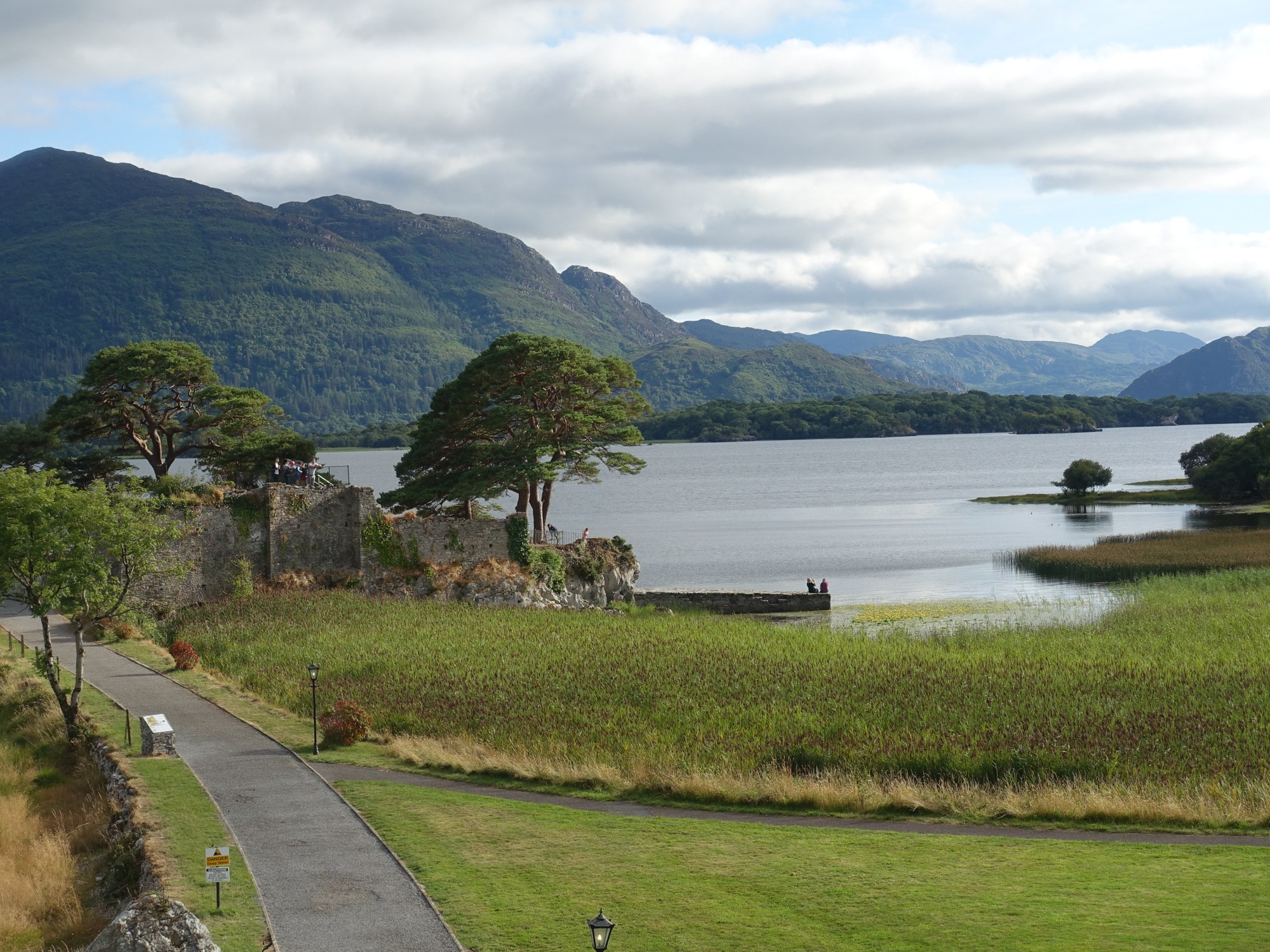
In Killarney we stayed at The Lake Hotel at Castlelough, just outside of the town. This historic family-run hotel has been in business for over 100 years, and is beautifully situated on Lough Lien (sometimes spelled Leane). The lake is in front of the hotel, and to each side spans the Killarney National Park and its high hills comprising many shades of green, and it is simply beautiful to behold. There, to our right, we could see the summit of Ireland’s highest mountain, Carrauntoohil (1038 metres). In its symmetry and beauty this vista reminded us of the Lakes District in England, and in some respects of Lake Louise in Canada (without the soaring mountains and glacier suspended above that lake). We were lucky enough to have a room overlooking Lough Lien with a view in the foreground, just metres from the hotel, of the ruins of a 12th century castle, Castlelough (castle by the lake). This castle was an important seat of the medieval local nobility and where Donal McCarthy, King of the Irish of Desmond, died in 1390. We strolled several times to these ruins to spend time gazing across the waters to the beautiful scenes beyond.


Lough Lien and the Lake Hotel, Killarney, Co. Kerry
Killarney town is a typically beautiful, although very busy, Irish town. Our highlights here were probably two: firstly, waking at 6 am on our first morning at the hotel, in the dim early morning light, to see a herd of thirteen wild red deer on the lawns of the hotel, resting, grazing, and the young deer running together and playing. No-one else was about, and we watched for half an hour before these deer melted back into the camouflage of the reed beds surrounding the lake as the day became brighter. While we had an occasional sighting of one or two of these wild deer at other times, this was the only time we saw them in a large, uninhibited group. Simply beautiful. Our other highlight was hiring a ‘jaunting car’ (a horse-drawn carriage, a very common mode of transport once in Ireland and still there for the tourists) for a ride through the national park. Our driver, Danny O’Shea, was very knowledgeable about local plant life, geography and history, and it was a fascinating tour. His horse, Molly Malone, was a beautiful little 10 year old mare, who was inclined to want to walk rather than trot (personally, we don’t blame her; some of the hills in the park were quite steep). It was a wonderful way to spend a couple of hours.


From Killarney we took the four hour drive up to Dublin, mostly utilising the motorways with their 120 kph speed limits. Here we stayed in an apartment in the St Stephen’s Green district, right in the city and handy to everything. Once we had settled in we had given ourselves a pretty large ‘to do’ list of cultural experiences in Dublin. Having returned our hire car to the Docklands area, we did the first of these: visiting the EPIC museum, located in Docklands: an extraordinary, privately-owned and ‘digital’ Irish Emigration Museum. Opened in 2016, this is a ‘must see’ in Dublin. Utilising digital technologies throughout, it documented the Irish diaspora of the 16th to the 20th centuries, celebrating Irish culture, and particularly celebrating the contributions that Irish emigrants and their descendants have made to many nations, and to the world: in the sciences, literature and artistic achievements, invention and innovation, politics and government, and entertainment. One could not help but to leave this place feeling uplifted and very admiring of the Irish as a people and a culture.


Just 100 metres along the road from EPIC was a haunting reminder of the other side of the emigration story, and the second thing we wanted to see in Docklands. These were the sculptures by Dublin sculptor Rowan Gillespie. The work is simply called Famine, and it depicts the emaciated and hopeless victims of the Irish famine, on the move and on the road, looking to escape the horror of the present for a better life. This is simply an unforgettable work. We had seen these figures in 2016 as we briefly toured the streets of Dublin in a bus, on a day trip from a cruise ship, and we wanted more time to appreciate this extraordinary work. It is set into the footpath beside the river as a public reminder of a world from which we have each, now so fortunately, been spared (at least in western countries. The same cannot be said for those who are fated to live marginal lives in developing nations).


“Famine” by Rowan Gillespie, Custom House Quay, Dublin
Other Dublin experiences on our bucket list? We visited the National Archaeological Museum of Dublin, which had a wonderful exhibition of artefacts, from all over Ireland, from the stone, bronze and iron ages, including some magnificent gold torcs and bracelets. It also had a fascinating exhibition of preserved human remains found in peat bogs, describing the nature of people they found in these places, and the sorts of tests that they now do on such archaeological finds and the information they are able to derive from them. We also visited the National Gallery of Ireland, where we saw a comprehensive collection of works from Irish artists and many others from around the world, some dating back to the 1300s. Particularly interesting was the Gallery’s collection of portraiture, which contained some very contemporary, engaging and exciting works.
Jenny was very keen to see the Book of Kells, a world-famous set of medieval manuscripts depicting the gospels and written by monks around 800 AD, and considered by many to be Ireland’s greatest cultural treasure. These are housed in Trinity College, Ireland’s oldest surviving university founded in 1592, and it is an experience to walk in through the narrow, old wooden front gate of the university and see the vast courtyard bordered by its old grey, stone buildings on all sides. Trinity College receives over 500,000 visitors each year, and there are long queues to see the Book of Kells, which is housed in the Old Library. Jostling with the crowds we did manage to get a good look at this amazing hand-written script and its attendant art work (hint: book your tickets for the Book of Kells online, as we did – the queue is much shorter). Following that, one walks up the stairs into The Long Room of the Old Library: an amazing, stunning, old, huge, cavernous, dark and dusty gallery; stories high, with literally every vertical square centimetre of space covered with old, weathered, and traditionally leather-bound books. People just enter this space and look up, mesmerised by it and the knowledge and history it represents. What a great experience.


A final highlight in Dublin was our decision to see Riverdance, which was playing at the old Gaiety Theatre, Dublin’s oldest surviving theatre, just around the corner from our apartment. This was not on our ‘to do’ list, but we saw that it was playing one day while walking past the theatre, found that a couple of seats were still available, and booked and attended the Saturday matinee a few days later. What better way to finish our Ireland excursion than to see Riverdance in Dublin? It was a full house, and the crowd loved it! The cast of young dancers, musicians and singers were so energetic and talented, and the lighting and sound added to the moods contained within the story: often sombre, but mostly uplifting and celebratory and joyful. On many occasions the audience clapped along with the cast as, somewhat like in the EPIC exhibition, they told the story of the Irish character and diaspora, and its interaction with and impact upon so many cultures around the world. The final act concluded by referencing the descendants of those Irish emigrants returning home to Ireland, many years later, to where perhaps even unknowingly their hearts, and the spirits of their ancestors, lie. This is something akin to what Jenny has been experiencing on occasions on this most wonderful of trips for us.
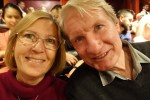
As Irish as it gets: Riverdance in Dublin
So, farewell Ireland, 2018! Next, a short flight back to London to catch our long 25 hour return journey (20 hours flying time), via Hong Kong, back to Australia. It has been a wonderful two weeks here, and we have enjoyed every minute of our driving tour of Ireland.
 Adventures for Two