This is the second part of our tour with APT, following our tour of the Canadian Rockies. Having left Victoria on Vancouver Island in the morning, we enjoyed a ferry trip from Swartz Bay to Tsawwassen, then arrived at the Vancouver cruise ship terminal around 1pm in time for a quick embarkation process. It was quick because while it is apparently common for the Vancouver terminal to process five cruise ships simultaneously, when we arrived there were only two in port, and we were among the later groups to arrive.
An Alaskan cruise attracted us because of the possibilities of spectacular scenery, especially glaciers and fjords, and of wildlife. This cruise , which we took as the second part of our APT tour on the Holland America Line ship the MS Volendam (capacity 1700 guests), lasted seven days.
A few things about Alaska we learned during the first day of the cruise. As many people may know, it used to be Russian territory in the 19thcentury, until it was sold to the USA for $15,000,000 back in 1867 (Russia, apparently, desperately needed the money). Unfortunately for Canada, Canada had only just become a nation in 1868, and it had neither the political strength or the money to compete with the USA to purchase this territory from Russia. So, the Americans moved fast and it became US territory, and then a state of the USA a century further on in 1959. Secondly, the border between Alaska and Canada is not, as we thought, simply a straight line on the map. It winds its way down the Canadian coast, grabbing a long strip of Pacific coastal territory for several hundred miles that would otherwise be Canada. We did not know this before this trip.
This is a popular cruise destination, and many cruise companies and ships cruise the Inside Passage (so-called because it avoids the wild open ocean) up to Alaska, providing many small communities along the way with an invaluable, and now in many cases, an indispensable source of income. From these various towns float plane (sea plane) and helicopter companies ferry people onto glaciers and for aerial sightseeing tours; boating companies offer fishing, glacier and whale watching experiences; bus and rail companies offer town tours, and tours into the mountains to see the sights and to visit a whole range of small businesses who have expanded their repertoires to secure more business, including hiking, zip-lining, dog-sledding, wildlife watching, wood chopping and so on.
In these towns local artists, artisans and fashion makers are displayed in local cooperative stores, and souvenir shops abound. With some of these small towns (ranging from 1000 to 10,000 people) hosting up to five cruise ships each day in the season, it is lucrative, and these towns are mad with activity and crowded. And for some reason, they all seem to be full of jewellery stores, side by side to each other, all spruiking glitzy and expensive adornments, with the spruikers standing outside of their stores on the main street trying to draw you in. At the end of the season in Alaska they apparently relocate, to the Caribbean or some other cruising mecca, to start the cycle again and attempt to flog more jewellery to unsuspecting tourists.
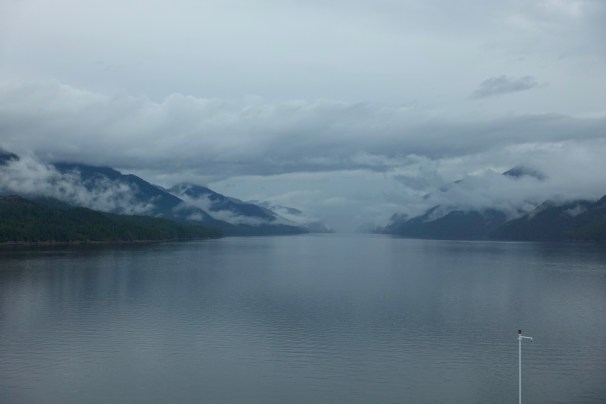
Our first day was a day at sea, weaving between small islands and tight channels, sometimes within just fifty metres of shore. This is a clear indication that we were travelling up old glacially-carved channels which have steep sides and cause little worry to ships’ captains. It makes for spectacular scenery and a great viewing experience, however, and we were on our cabin balcony, and later in the forward viewing area of the Volendam, the ‘Crows Nest’, to drink in these views, with Jenny madly taking photographs. On our second night we had to move the clocks back one hour, as we had been travelling steadily westward and were no longer on Canadian Pacific Coast time.
Our first port of call was the city of Juneau– Alaska’s capital city (we are so ill-informed, as before this cruise we thought that the capital was Anchorage, to the north). Having attended a lecture on the ship of all the tours and experiences on offer, we decided to take a boat tour way down a fjord to see a magnificent glacier as it meets the water. We were not disappointed, and this is perhaps the best day we have had on our trip so far (which is saying something, because most days have been quite wonderful).
The fjord we travelled down is called Tracy Arm, named for the US Secretary for the Navy B.F. Tracy (1889-1893). The glacier we visited is called the Sawyer Glacier. Originally one large glacier, the Sawyer has now receded to a point where it is two connected glaciers: the Sawyerand the South Sawyer. This was the first tour offered on this ship, as all of the 100 participants were transferred from the Volendam onto the smaller catamaran in mid-passage (quite an experience!), well before the ship reached Juneau. This catamaran tour was provided by local firm Allen Marine, and the captain and crew, which included a naturalist, were very helpful and knowledgeable. Within five minutes of leaving the ship and heading swiftly towards the mouth of Tracy Arm Fjord, we saw our first iceberg (great excitement), the first of many that had calved off from the glacier many miles inland and up the fjord.


Tracy Arm is a fjord of stunning proportions. Imagine the scenes used to frame the opening credits in the Jurassic Park movies – soaring cliffs rising majestically amongst clouds from valley floors far below, dwarfing a light plane flying along the cliffs’ edges. This was like that, except these cliffs rose from the water of the fjord and plunged steeply a further 600 feet below the cold surface waters. Some of these cliffs rose thousands of feet, and some of the mountains lining the fjord rose over 7000 feet above the water – the height of Mt Kosciuszko, Australia’s highest mountain. Parts of this fjord are over 1,000 feet higher than the deepest parts of the Grand Canyon! Food for thought, and it explains the profound impact that this experience had on the people who viewed it during our tour.
The experience was overwhelming, a fact reinforced by the silence of those 100 people on the catamaran as we made our way up the fjord for the first time. We were simply looking in disbelief at this stunning natural beauty, this awesome spectacle and testimony to nature’s power, drinking it in, and craning our necks to try to see up to the heights that soared above us. These cliffs were carved out 20,000 years ago by massive walls of ice forcing their way south to the sea – so thick at that time that they reached the top of many of these cliffs. The advancing ice wall scoured the landscape and carved out and marked the stupendous valleys we now see. These days incredibly high and deep valleys, beginning in these dizzying heights, now host beautiful waterfalls that stream and cascade down mountain walls and steps and into the fjord far below.


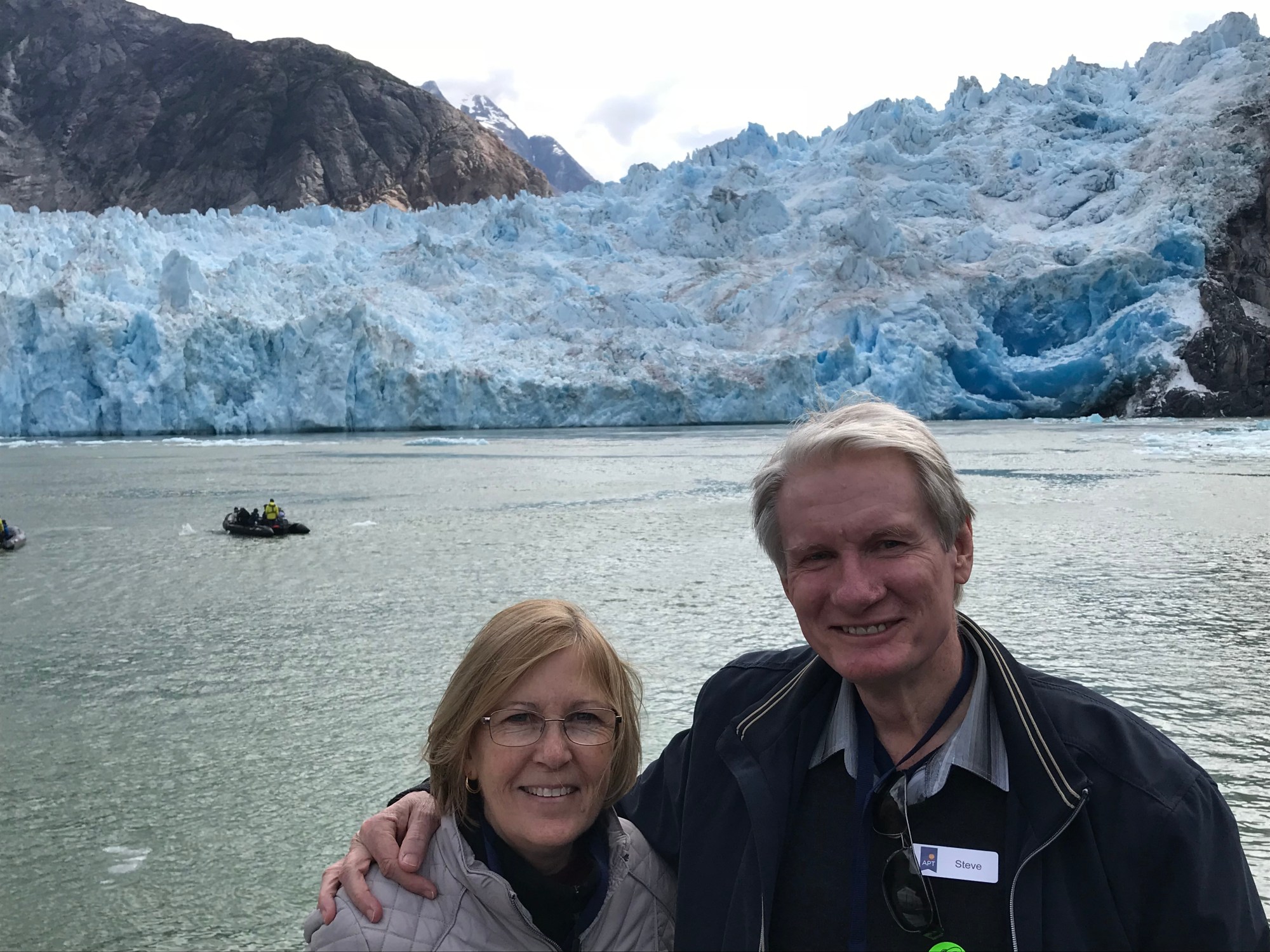
Now, the South Sawyer Glacier has receded around 30 kilometres from the present ocean, which was its most advanced point in antiquity. Sailing towards the current glacier’s face we saw icebergs of increasing size, calved off from the glacier many miles inland, gradually melting in the water as they travelled to the sea, and the oldest glacial ice in them marked by deep greens and blues. Our excitement grew as the icebergs increased in number, a sign that the glacier itself was getting nearer. And then around a final bend in the fjord, and there it was – a high, jagged, tumbled, beautiful white, grey and deep blue-green wall of ice, spanning the width of the fjord. This magnificent ice wall towers over 200 feet above the water and 900 feet below us. Immediately many on the boat gasped ‘aaah!’ as a large sheet of ice on our right hand side of the glacier broke away and fell into the water. What a welcome! This ‘calving’ of the ice wall was to happen a further three times as our catamaran laid off the glacier, amongst other craft, perhaps only 200 metres from the ice wall, enabling us to have the most exhilarating of views (any closer is simply not safe, it was explained. The reasons are obvious).
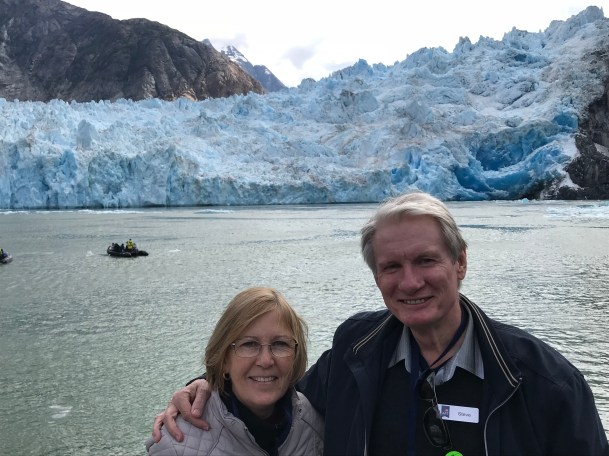
Jenny near got frostbite as she persevered with photo after photo with the occasional video thrown in (it was not freezingly cold in Alaskan terms, but the wind did chill the bones). It was simply amazing to spend 45 minutes there observing, and marvelling at, this momentous phenomenon of nature and geological history. While doing so we saw bald eagles flying over the glacier and harbour seals lying on the nearby ice floes with their young pups. We also saw small flocks of Arctic Tern– amazingly high-powered little birds (they only weight 350 grams) that attacked the water in the fjord looking for food. These beautiful and tough little terns are the longest migrating birds of any species on the planet, travelling 25,000 kilometres on their Alaska to Antarctica round trip each year!
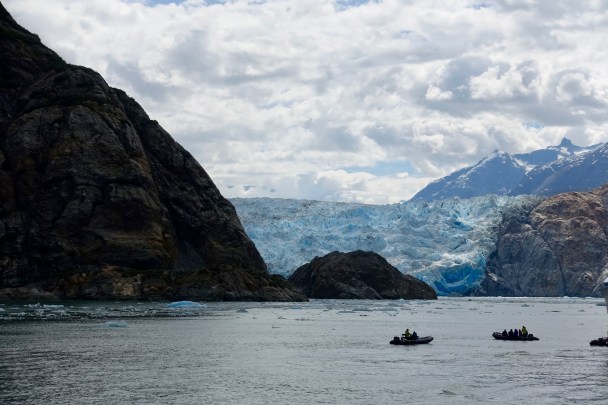
On the return journey from the glacier we saw other wildlife, quite rare to spot in the fjord – a humpback whale moseying up the fjord seeking out food, a mother mountain goat and her two kids momentarily visible on the incredibly steep walls of the gorge, and, out in the more open water towards Juneau, Stellar sea lions and harbour seals at play. This was a six hour trip and a long day, but well worth it. The catamaran took us into Juneau harbour, completing our journey and enabling us to re-join the Volendam, and it was clear that everyone felt that we had had a magical day. Several things we have since read suggest that if you only had one day to spend in Alaska, the Tracy Arm Fjord and Sawyer Glacier experience should be the destination you choose! After our experience, we certainly agree.
Later in the day we went for a quick walk around the town of Juneau, avoiding all the spruiking jewellery shops, and headed back to the boat for a well-earned rest while the ship sailed overnight for the more northern port town of Skagway.


The first thing that strikes you about Skagway is how strongly it resembles a Wild West frontier town. The town owes its existence to the discovery of gold in the Yukon in 1896, and its many surviving turn-of-the-century buildings give it an air of timelessness. Today, one of the most popular tourist attractions is the White Pass and Yukon Route Heritage Railroad. Apparently the trip affords passengers spectacular views but, having very recently completed the Rocky Mountaineer journey from Vancouver to Banff, we decided another long train journey so soon wasn’t for us. Instead, we roamed the town of Skagway, enjoying the atmosphere and avoiding the ever-present jewellery sellers.


Skagway, Alaska
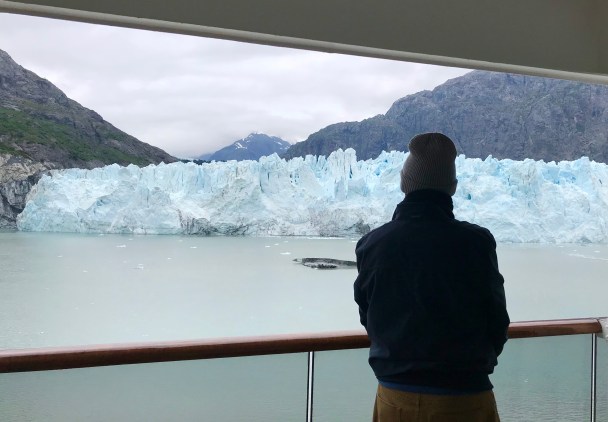
Travelling north from Skagway we entered the Glacier Bay National Park and Glacier Bay. This is an amazing place in which ten glaciers are found within a small area. These glaciers were once all joined into a single powerful and gigantic ice sheet, which carved out this bay only 400-300 years ago, forcing out the Tlingit First Nations peoples who lived here. In the last 250 years however the glaciers have abruptly retreated, and now only three reach the water in the Bay. It was a clear and overcast day when we visited Glacier Bay, the northernmost point of our trip, and the brooding stone hills surrounding the bay, covered in misty clouds and pockets of snow, was indeed a beautiful sight. For us, it did not compare with the soaring, magical cliffs and the steep, plunging valleys and waterfalls we saw in Tracy Arm several days earlier.
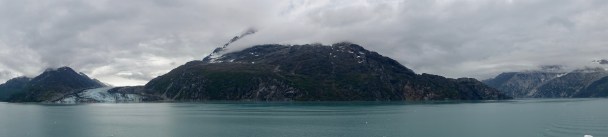
However, our ship was able to spend a lot of time opposite one stupendous glacier which is still anchored in the Bay, towering above us despite we being on Deck 7 of our ship. This certainly matched the South Sawyer Glacier in Tracy Arm Fjord, and as we watched this glacier, its occasional calving of ice from its walls was announced with cracking rending the air like cannon shots booming across the still bay. Large gulls, three of which landed on our balcony rail, wheeled and squawked across its face, and several bald eagles perched majestically on top of ice floes, unperturbed by what was happening around them. It was all so beautiful, and it captured the full attention of everyone on board. While Glacier Bay does not have the extraordinary plunging fjord lines of the Tracy Arm further south, it is certainly in its own way unique, being the meeting point of so many recently joined glaciers, and we are glad to have had the chance to see it.


Glacier Bay National Park
Our final port of call in Alaska was Ketchikan, on the shore of the Tongass Narrows. Unlike Skagway, Ketchikan wasn’t built on the discovery of gold, but rather on salmon. It proudly bills itself as “The Salmon Capital of the World” (although we’re not sure what the Canadians think about that!). Ketchikan Creek, which runs right through the centre of town, is a key site of the annual salmon migration and spawning, with the concrete fish ladder still there to help them on their journey upstream over the falls.
We visited the Tongass Historical Museum, which has a very interesting permanent collection explaining the history of the town, as well as a current temporary exhibition of historical photographs of the area. From the establishment of the first salmon cannery in 1886, Ketchikan grew rapidly, taking advantage of the abundant timber in the area. All of the older houses are built of timber, and in many places timber boardwalks remain. Creek Street, built on stilts to avoid the tides and originally the infamous ‘red light’ district in town, survives today as the home of numerous art and craft stores, bars and cafes.


Views of Ketchikan, Alaska
Today, Ketchikan relies heavily on tourism, particularly from the many cruise ships (there were four in port on the day we were there). Like in Juneau and Skagway, dozens of jewellery stores set up shop in Ketchikan in the summer months, only to move on when the season ends. Thankfully, we managed to avoid these, as well as the many spruikers selling day tours (everything from floatplane flights over the Misty Fjords National Monument, to the Great Alaskan Lumberjack Show), and enjoyed a quiet stroll around town. Later, as our ship pulled away from the dock, we were able to watch five bald eagles soaring over the town and landing high in the trees. We like to think these majestic birds were bidding us farewell!
Just one more day at sea and our Alaskan sojourn was over, and on the return journey to Vancouver reacquainted ourselves with the stunning coastal forests, islands, tidal passages and mountain scenery of the south-east Alaskan coast. We’ve seen the magnificent scenery we’ve long heard and read about, and are now looking forward to the next leg of our current adventure: New York!
 Adventures for Two
Thanks Jenny and Steve. Enjoying the tales of your travels and taking notes for our future adventures 🙂 Cheers, Ken and Sissi
LikeLiked by 1 person
Thanks, Ken! Glad you are enjoying it. Take care, Jenny and Steve.
LikeLike
WOW – what an amazing trip! One that Gary and I would like to do when we retire. Will have to tell Wayne that there’s a glacier named after him – ‘South Sawyer Glacier’!
Great to see you both enjoying retired life and travelling as much as possible 🙂
LikeLiked by 1 person
Hi Nic, nice to hear from you. Yes, it’s a great trip to do, and please do let Wayne know the good news!🙂
LikeLike